Q‑Commerce Business Model: What Is Quick Commerce and How It Differs from E‑Commerce
Business
E-commerce development


Here, you’ll find the essential facts: how q-commerce operates, how it has evolved on both sides of the Atlantic, and how global dynamics reshape the model. We chart its benefits, its momentum, and the companies that have already defined its first chapter. For a deeper look at your market, the door at IntexSoft is open.
Reading time: 17 min.
Trends don’t last forever, but one thing seems here to stay – our demand for instant everything. From coffee to noodles, people today expect speed, and that’s true for shopping, too.
That’s where quick commerce steps in. Sparked by Covid-19, it’s become a key part of how we live – fast, flexible, and right on time.
But what exactly is q-commerce definition?
Quick commerce, or q-commerce, is all about speed. This emerging business model shrinks the time between placing an order and getting it delivered – often in as little as 10 minutes to half an hour.
As we have mentioned above, born during the pandemic, q-commerce filled a critical gap when traditional shipping couldn’t keep up with demand. It focuses on delivering smaller quantities of essentials – think kitchen items, snacks, or medicines – right to your doorstep.
What’s more, another reason that might get you thinking about this shift is how it changed expectations. We now live in an era of “I want it now,” and businesses are racing to keep up. As companies swap ideas on logistics, technology, and speed, q-commerce keeps proving one thing: convenience truly sells.
In Berlin, two local startups – Gorillas and Flink, both founded in 2020 – raised billions of dollars in funding within months. In the U.S., Gopuff surged ahead with over 120,000 daily active users, helping drive the American q-commerce market size to a whopping $62 billion in revenue – nearly five times the size of Europe’s sector that same year.
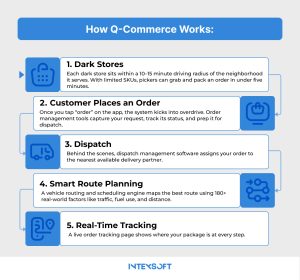
The q commerce business model runs on precision and proximity. It’s built around three key layers – a central hub, distribution centers, and dark stores (also called micro-fulfillment centers) that handle the last mile.
These dark stores are compact warehouses, usually 250 to 5,000 square feet, stocked with 500 to 2,000 unique items – everything from snacks to medicine. Strategically placed close to consumers, they’re designed for one thing: speed.
It starts with a tap. The instant a customer places an order, the system snaps into motion. Within seconds, algorithms coordinate dark stores, distribution hubs, and couriers zipping through city streets – all choreographed to hit the 15-minute mark.
Behind that speed is precision data. Predictive models scan trends and weather patterns. The result? Smarter stock levels, optimized warehouse flow, and delivery networks that learn – and get faster – with every order.
Simply put, q-commerce companies are learning to be better at balancing speed and precision – ensuring your order arrives fast, fresh, and right on time.
Designing a lean, efficient dark store – where workers don’t waste time searching for items or moving unnecessarily – is key to delivering on speed.
Behind every 10-minute delivery is a digital brain – the warehouse management system, or WMS. Synced with smart sensors and AI dashboards, it watches every product’s journey across warehouses, distribution hubs, and dark stores. When the algorithm senses a rush – say, iced drinks trending on a hot afternoon – it fires off an auto-restock alert before your order ever hits “out of stock.”
Here’s a closer look at where it’s making the biggest impact.
Surveys show that many customers now do a large part of their weekly grocery shopping through fast-delivery apps – ordering everything from fruits and vegetables to dairy staples. In fact, nearly half of users in Europe rely on these services for their regular grocery needs. About a third say q-commerce now makes up nearly 40% of their total grocery spending.
Of course, convenience comes at a price – sometimes literally. Studies show q-commerce baskets average about 17% higher than supermarket prices, plus delivery fees. Yet, most shoppers don’t seem to mind. Almost half of customers in Germany, France, and the Netherlands say a small surcharge – about €2 on a €20 order – is worth it for the speed.
For brands, this means a major opportunity. The European q-commerce market is expected to nearly double to €8.7 billion by 2027, led by the U.K., France, and Germany. The model shines brightest in dense urban areas, where every minute and every kilometer counts.
In big cities, getting medicine is now as easy as ordering lunch. Need cold meds or vitamins? You can have them at your door in less than 30 minutes – no lines, no waiting, no panic pharmacy runs.
Q-commerce platforms are teaming up with local pharmacies to make that happen – ensuring safe packaging, accurate prescriptions, and even temperature-controlled delivery.
For pharmacies, it’s a win. This means tapping into new customers and staying relevant in the age of instant everything. For consumers, it’s simple: faster care, delivered straight to your door.
Demand for ultra-fast meal delivery has shot up dramatically in the past two years, with platforms now serving everything from hot, ready-to-eat meals to chef-led meal kits. In several major cities, these quick meals account for more than a quarter of all q-commerce orders.
At the center are cloud kitchens – lean operations designed for one mission: rapid delivery. These kitchens optimize workflows down to the second, cranking out meals that jump from prep station to courier almost instantly. Think sushi, power salads, burgers, and even high-end options crafted for speed.
Meanwhile, meal kits are riding their own wave, hitting the sweet spot between convenience culture and the modern desire to “cook without actually cooking.” And all of this q-commerce covers.
It’s not just consumers hitting “order now.” Businesses use q-commerce to refill supplies – from restaurants topping up ingredients to offices restocking coffee pods and printer paper. This model, known as urban micro-restocking, cuts downtime and keeps operations flowing smoothly. The result is leaner inventory management and lower waste across city networks.
When it comes to e commerce vs q commerce, the difference isn’t just about how fast your package arrives – it’s about how each system is built to serve a changing world of shoppers. Both models work beautifully in their own ways, but one is designed for speed, and the other for scale.
| Comparison Point | E-Commerce | Q-Commerce (Quick Commerce) |
| Delivery Time | Originally built for speed within hours or days. | Delivers in 10–30 minutes – lights the way for instant service. |
| Delivery Technique | Uses vans or trucks for bulk orders. | Uses scooters and bikes for quick, local drops. |
| Fulfillment Centers / Warehousing | Centralized warehouses on city outskirts. | Small dark stores or micro-hubs close to customers. |
| Product Range | Huge variety – from tech to clothing. | Focused on essentials like food, medicine, and home goods. |
| Order Size | Larger carts for planned buys. | Small, quick orders – usually 1–5 items. |
| Pricing Structure | One global price list. | Local prices vary by area and demand. |
| Business Focus | Built for scale and reach worldwide. | Built for speed and proximity in cities. |
| Customer Type | The planner – values choice and deals. | The impulse buyer – wants it now. |
| Profitability | Stable, proven, and scalable. | Still testing models; thin margins challenge growth. |
| Eco Impact | Bigger vehicles, longer routes. | Shorter trips; two-wheelers work beautifully for quick runs. |
| Reach | Global – delivers across borders. | Urban – thrives in dense neighborhoods. |
| Future Outlook | Keeps evolving with automation and data. | Lights the way for instant, hyperlocal delivery – complementing e-commerce, not replacing it. |
Sure, customers love the speed. But quick commerce delivers plenty of upside for brands as well. From higher visibility to stronger customer loyalty, the benefits stack up quickly. Below are three of the top perks brands can count on.
When customers know an order can arrive in minutes, they’re more willing to try new brands and switch stores.
Executives say this speed creates a competitive pressure point, one that reshapes how companies contend with Amazon’s scale and the neighborhood stores that have long held territory.
Deloitte found that, at the height of the pandemic, half of all shoppers paid more simply to get what they needed faster. They opened their wallets for on-demand delivery and BOPIS because time suddenly had value measured in minutes.
Businesses that lean into q-commerce’s narrower product mix can push their highest-margin items to the front of the line. For busy professionals and high-income city workers, saving time beats scoring a discount. That simple preference is turning q-commerce into one of the more profitable corners of online retail.
As shoppers expect faster service, quick commerce helps retailers rise to the challenge – and build loyalty along the way.
The problems it solves are familiar, and most are tied to moments when customers simply need things fast.
In those situations, q-commerce delivers quick relief. It cuts stress, prevents last-minute hassles, and gives customers a clear reason to stay satisfied.
Companies are fine-tuning operations to meet the demands of “now.” But the geography of innovation tells a surprising story: the U.S. isn’t leading this race – Europe is.
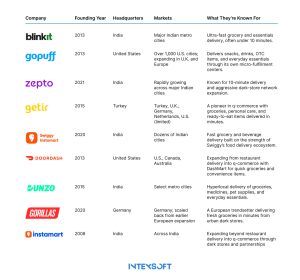
Outside of GoPuff and JOKR, the dominant players all trace their roots back to European hubs. In Western Europe, new q-commerce startups are emerging consistently, fueling a hypercompetitive ecosystem.
So who made the established names list?
As shoppers crave faster service, more companies are turning to the q commerce business model – a system built for instant gratification. Very broadly, it’s the fastest-growing branch of e-commerce, reshaping how businesses handle orders, storage, and delivery to meet the need for speed.
To make it work, there are a few key steps companies are taking to keep up with this rapid-fire retail trend:
Speed starts with proximity. Companies are building local hubs – small, strategically placed warehouses – to manage everything from order pickup to packaging and delivery.
Having a hub within reach helps businesses:
This approach keeps operations affordable while maintaining the fast pace that defines q-commerce.
In this model, staying prepared is half the battle. Brands conduct market research to predict which items customers want most – from snacks to everyday essentials. Then, they stock products in nearby hubs to ensure instant availability.
Here are the biggest trends lighting up the quick commerce space:
Groceries may dominate now, but that’s changing fast. Q-commerce players are branching out into medicine, books, electronics, and even furniture. Startups like Spain’s Glovo are leading the charge with instant delivery of tech and home essentials – a sign that 60-minute shipping isn’t just for snacks anymore. The next frontier? Quick commerce in USA, where apparel and accessories reach your door before your next meeting.
Speed only works when supply chains do. Companies are tightening operations with real-time inventory tools that show what’s in stock and where – down to the nearest “dark store.” AI now helps delivery partners find backup locations instantly, saving precious minutes and keeping perishables fresh.
AI and machine learning have given q-commerce brands a powerful edge. We mean the ability to predict demand before it happens. Personalized alerts, dynamic layouts, and fluid UX are the pulse of next-gen quick commerce.
Big brands see q-commerce as the fastest route from thought to doorstep. Even luxury names are getting on board – Estée Lauder’s 60-minute delivery partnership with Uber is just the beginning. Expect more influencer-led, rapid delivery drops that blend instant access with social buzz.
At the heart of q-commerce are its “dark stores” – compact, hyperlocal warehouses designed for efficiency. Using AI insights, companies are mapping where new hubs should go based on purchase volume and delivery data.
The story of q-commerce has always been about speed. But now, executives know the era of disposable packaging and fuel-heavy fleets can’t continue. They’re testing electric vehicles, recyclable containers, and green delivery systems – a revolution toward sustainability.
With its explosive growth, the q-commerce market size is projected to soar in the coming years. The right mix of technology, smart logistics, and customer experience will decide which brands stay ahead.
2026 and beyond promise exciting shifts – whether it’s fresh food in 15 minutes or fashion q commerce that delivers runway looks by lunchtime.
If your business is ready to ride the instant delivery wave, IntexSoft can help you build the tech to make it happen – from idea to launch.


This post delves into seven effective options to bolster online payment security.

In this article, we explore the patterns behind ecommerce vulnerabilities and how AI is redefining both risk and protection.
This article discover such questions as how AI technology is revolutionizing inventory management and accelerating business growth and how implementing AI solutions can streamline operations, optimize inventory levels, and improve forecasting accuracy.