

What if your warehouse could see, think, and adapt in real-time? IntexSoft dives deep into the future of logistics with a look at supply chain digital twins, where AI, computer vision, and real-time data converge. From predictive insights to smarter inventory flows, this article breaks down what digital twin warehouse tech means for businesses. Want to see how it fits your operation? Get a free session with our team.
Reading time: 14 min.
A digital twin isn’t just a sleek virtual mock-up of a machine or building. It’s a living, breathing digital organism, constantly evolving and constantly learning. Fed by sensors. Driven by data. Supercharged by machine learning. It’s an advanced replica or a real-time mirror that shows you what is, what could be, and what you need to do next. In short, it’s a simulation that sees the future.
The buzzword may sound new, but the idea is decades in the making.
The term “digital twin” surfaced in the early 2000s, but NASA was already deep in the game. The company utilized virtual counterparts of spacecraft systems to plan missions and model damage scenarios. Go back further, and you’ll find the early DNA of the concept embedded in the Apollo program of the 1960s, where mirrored simulations helped troubleshoot problems in space.
Digital twins aren’t future tech. Businesses are using it right now.
What’s changed? Bandwidth. AI. Sensors. Cloud computing. We finally have the tech stack to make digital twins not only viable but operational at scale.
Digital twins have officially crossed the threshold from innovation to implementation. No longer confined to R&D labs, they’re rapidly becoming integral to enterprise operations worldwide.
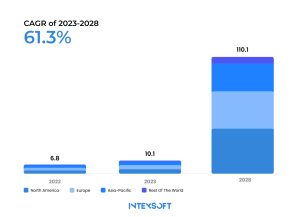
Let’s demonstrate it, showing the impact and significance of digital twins across various sectors:
Here’s the real kicker: a digital twin is a decision-making engine. Real-time data flows in. Predictive models analyze it. Engineers, doctors, and operators get an insider look at what’s coming next. As we digitize more of the physical world, simulations tighten their grip on reality, leaving almost no gap.
You don’t have to be NASA to build a digital twin anymore. The tech isn’t reserved for aerospace giants or trillion-dollar conglomerates. Thanks to platforms like Azure Digital Twins, Siemens MindSphere, and PTC’s ThingWorx, the barriers to entry are collapsing. Fast.
Welcome to the democratization of digital twins. What was once an elite, resource-intensive innovation is now within reach for small and mid-sized businesses. Off-the-shelf IoT sensors. Prebuilt AI modules. Plug-and-play cloud infrastructure.
In this piece, IntexSoft zeroes in on the practical advantages businesses can unlock through digital twins in logistics.
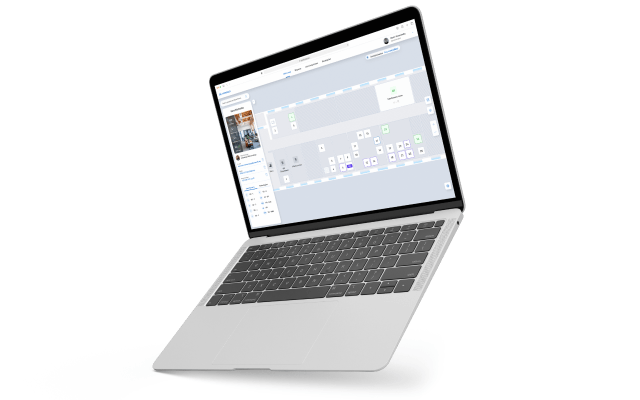
Digital-twin warehouses are riding a serious wave. They’re delivering real, measurable efficiency. At scale.
Here’s what’s making them essential:
Traditional warehouse operations have long relied on tried-and-true methods. In reality, they often have put all of a company’s eggs in one basket, depending on manual oversight and rigid systems.
But now, the digital twin explained: these aren’t just static models. They are real-time replicas pulling in streams of data from IoT sensors, cameras, RFID tags, and more, offering a full 360-degree view of what’s happening on the ground, second by second.
Forget about swapping out a ‘vanilla’ version of a software solution for something flashy. We offer a fundamental shift in how warehouses operate:
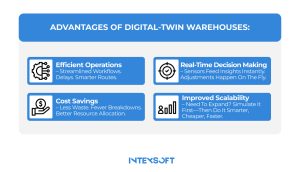
Every unplanned delay is a dollar lost. Every misrouted shipment? Multiply that by hundreds of SKUs a day. Digital twins plug the money leaks you didn’t even know existed.
Predictive maintenance in the digital twin supply chain means you don’t wait for the conveyor to break. Quietly, the sensors warn of stress. Minutes before the failure. A technician acts. Elsewhere, the shelves (once chaotic with overstock) begin to balance. The scramble to fill gaps disappears. And in a back office, staffing plans were adjusted, not by instinct, but by numbers no one had trusted before.
And here’s the kicker: you can simulate cost-saving strategies before implementing them. Want to test a new layout? Adjust pick-pack paths? Switch shift rotations? Run it all through the twin first.
Traditional warehouses run on reports. Digital-twin warehouses run on now. With sensors feeding streams of data into a constantly updated model, these systems can detect bottlenecks, forecast delays, and even recommend alternatives instantly.
Need to reroute inventory due to a weather disruption? The twin already has options mapped out. Noticed that one loading dock is consistently slower? The model spots the trend early.
With decision-making this sharp, you cut waste, reduce downtime, and slash errors, all before your competitors even realize there’s an issue.
Growth doesn’t have to mean growing pains. With digital twins, you can model new floor plans, test demand surges, and explore automation upgrades (all without disrupting existing operations).
As your operation expands, the twin learns. It grows with you, adapting to new workflows, geographies, and market conditions. What used to take six months to roll out can now happen in weeks. Your warehouse is truly scalable.
From smarter inventory strategies to predictive maintenance routines, here’s how digital twins are being hardwired into warehouse operations and what that means for agility, speed, and resilience at scale.
Let’s explore the table below:
| Application | Description | Why It Matters | Example Use Case |
| Real-Time Monitoring and Visibility | Your warehouse’s heartbeat is captured through real-time IoT feeds (from forklifts to cold storage). | Spot problems the moment they arise. Cut downtime and lost revenue. | A sudden temperature drop in a fridge zone triggers instant alerts, saving thousands in spoiled goods. |
| Warehouse Simulation for Strategic Planning | Run “what-if” scenarios on layouts, tech upgrades, or process shifts (all in a virtual sandbox). | Reduced planning risk, better resource allocation, cost efficiency. | Simulate adding a conveyor belt to see if it speeds up order picking before spending a dime on installation. |
| Predictive Analytics for Proactive Problem Solving | Use data history and live insights to forecast equipment failures and workflow snarls. | Prevent expensive breakdowns and chaotic delays. | Detect when a forklift is due for maintenance (fix it before it brings your operation to a halt). |
| Smarter Inventory Management | AI-powered models track, predict, and optimize stock levels based on live and historical data. | Slash overstock costs and avoid empty shelves. | Automatically reorder best-sellers during peak season, keeping shelves stocked without overbuying. |
| Strengthened Security and Risk Management | Digital twins simulate safety incidents and monitor facility access, fire hazards, and environmental threats in real time. | Improved safety, faster incident response, reduced insurance risk. | Identifies a blocked fire exit during a simulation drill and automatically reroutes evacuation plans. |
Let’s get one thing straight: warehouse digital twins don’t just run on data. They run on sight. And the tech that’s taking this revolution from impressive to unstoppable? Computer vision.
We’re not talking about some add-on tool here. Computer vision is the neural input that gives a warehouse twin its reflexes. It’s the tech that spots, interprets, and reacts to everything happening across your operation in real time. But its real power? That kicks in when it’s fused with other bleeding-edge tech.
Here’s where things get serious:
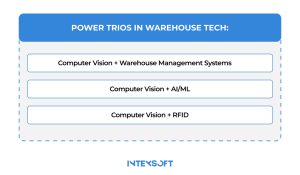
A digital twin without good data is just a guess dressed in code. That’s where WMS platforms come in: they organize inventory data, track movement, and keep the logistics humming. But even the best WMS is only as accurate as the data it’s fed.
If data collection relies on slow, error-prone manual scans, your million-dollar WMS could still leave you with mismatched stock and mystery shortages. Enter computer vision.
With systems like Vimaan’s StorTRACK, inventory is visually scanned, discrepancies are flagged in real time, and updates flow automatically into your WMS. This isn’t about speed for the sake of speed. It’s about eliminating blind spots and building trust in your inventory numbers.
Here’s the other side of the coin. The sheer volume of video and sensor data pouring into a warehouse digital twin is enormous. Enter artificial intelligence and machine learning, the processing power behind the perception.
AI doesn’t just see what’s happening. It learns from it. Pattern recognition, anomaly detection, predictive analytics are the features that let a digital twin forecast problems instead of just reporting them.
From heat maps of workflow slowdowns to automated suggestions for layout optimization, AI makes computer vision smarter over time and makes you faster, leaner, and more resilient.
Not every item in a warehouse plays nice with cameras. Some are obscured. Some are packed tightly. Some just exist outside the visual line of sight.
Blending RFID with computer vision creates a kind of hybrid superpower: what one tech misses, the other catches. In warehouses with especially complex tracking needs, Vimaan has already integrated RFID with StorTRACK, creating a layered solution that balances visibility, accuracy, and flexibility.
The result? A supply chain that doesn’t blink.
If you run a warehouse business, here’s the truth: standing still isn’t an option anymore.
The numbers are clear. As logistics networks expanded, cracks began to form, coordination slipped. Companies needed X-ray vision to act wisely. That is why digital twins as a new tech became a necessity. Inside major hubs and across growing networks, operators turned to real-time simulation to keep the chaos at bay. It worked.
Here’s what you can do next:
Digital twins turn your warehouse from a reactive space into a proactive machine. And with the tools now accessible even to mid-sized businesses, the question isn’t “can you afford it” — it’s “can you afford not to?”
If you’re ready to explore what a digital twin could do for your warehouse, the team at IntexSoft is here. Our logistics experts offer free consultations to help you.
Contact us anytime.

In this article, we explore the patterns behind ecommerce vulnerabilities and how AI is redefining both risk and protection.
This article discover such questions as how AI technology is revolutionizing inventory management and accelerating business growth and how implementing AI solutions can streamline operations, optimize inventory levels, and improve forecasting accuracy.
The article explores AI's impact on ecommerce, highlighting its role in enhancing customer experiences and driving revenue.