

In this article, you will explore both sides of the coin when it comes to AI customer service agents. We highlight the benefits as well as the more controversial considerations. We also examine five of the most ubiquitous solutions currently available on the IT market. And if you need a helping hand, our experts are always available.
Reading time: 17 min.
So, what is autonomous customer service? It’s a service handled by algorithms, powered by AI and natural language processing. Think of it as something that replaces traditional support roles. These systems respond to customers in real time, make decisions, and adapt without human guidance. And when they hit a wall, they escalate – without delay.
An AI customer service agent is smart software that talks, listens, and gets things done – whether it’s tracking packages or authenticating your voice. The advanced ones respond and learn simultaneously. They read tone, gauge urgency, and tailor replies in real time, getting sharper with every interaction.
Over the past year, generative AI has taken over the workplace. Nowhere was the shift louder than in contact centers. Voice authentication led the charge, followed closely by process automation. Behind the curtain, sentiment analysis and intent prediction started pulling the strings, transforming how machines understand human emotion – and what to do about it.
How do they work?
At a basic level, here’s the flow:
65% of U.S. contact center employees said their voice was constantly being recorded by AI tools.
Nearly half reported that their tone and emotion were being monitored by machine learning models.
And yet, slow resolution times and bot misunderstanding still remained key customer frustrations – proof that the technology’s promise hasn’t yet met its full potential.
But the market is doubling down.
Conversational AI is expected to be among the top investments for contact centers over the next two years, and automated process handling is quickly climbing the ladder of adoption. Even with the growing pains – AI hallucinations, incomplete handoffs, and awkward phrasing – companies are betting big.

To understand why AI agent for customer service actually matters, look at the following list of benefits:
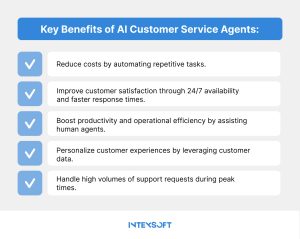
Now, we uncover all the details of each point.
Let’s be honest – no human wants to spend their workday copy-pasting tracking info or answering “How do I reset my password?” 50 times in a row. This is exactly where AI agents customer service shines. They handle high-volume, low-emotion queries with zero fatigue and near-instant turnaround. Whether it’s managing order status, answering FAQs, or verifying account details, AI can do it with precision, 24/7.
IntexSoft acknowledges that process automation is one of the fastest-growing use cases in global contact centers. With AI in place, companies are seeing up to 30% reductions in customer service operating costs while improving resolution speed. These agents aren’t replacing humans; they’re clearing the clutter so human agents can focus on real problems that require empathy, context, and complex decision-making.
Customer expectations have changed. Fast. In the world of e-commerce, SaaS, and even healthcare, immediacy is the baseline. AI agents meet this demand by staying online around the clock – ready to engage in a dozen languages, across time zones, on multiple platforms. No delays. No “We’ll get back to you in 24–48 hours.” Just instant, context-aware replies.
Holiday surge? Crisis-level traffic? No problem. AI scales instantly – 10,000+ conversations at once. Zero lag. Maximum coverage. Meanwhile, they’re gathering valuable metadata – sentiment, intent, frequency – to fuel analytics, train models, and refine future responses.
The smart ones escalate to human agents automatically, passing along the entire conversation thread and context, so there’s no awkward “Can you tell me your issue again?”

It’s important to kill the myth: AI doesn’t replace your support agents – it turns them into superheroes.
Today’s customer support AI agents categorize tickets, fetch user history, suggest replies, and trigger backend processes. As we highlighted above, that means your human agents spend less time clicking around dashboards and more time solving the stuff that truly matters.
Companies using hybrid support models – AI and human agents side by side – have reported up to 40% faster resolution times, 20–30% more tickets handled per shift, and higher customer satisfaction scores across the board. Less mental overload. Fewer bottlenecks. More output, same headcount.
A generic “How can I help you?” doesn’t cut it.
For example, a customer reaches out about a billing issue. Before they type a single word, the AI knows they recently upgraded their plan, saw a charge yesterday, and contacted support last month about a similar concern. Within seconds, the AI suggests a targeted solution or escalates with all context attached.
According to McKinsey, personalization done right can drive 10–15% revenue growth while slashing churn rates.
Humans burn out. AI just scales.
When demand spikes, AI agents are on the front line. They don’t need to be trained or scheduled. They automatically scale up to handle thousands of conversations simultaneously – no extra headcount required. No queues. No wait times.
During high-volume periods, businesses using AI agents report up to 70% reductions in average wait time and 60% more tickets resolved without human intervention. That’s not a minor boost – it’s an operational shift.

The promises are 24/7 support, faster resolutions, and happier customers. But before you contact AI-powered customer service agents, take a hard look under the hood. Behind every seamless reply lies a tangle of real questions – budget, bias, data risks, and a time-to-value that rarely runs on schedule. The tech shines, but the road to results is rough, and not every business is built for the ride.
Because here’s the twist: not every organization is ready for AI at the front lines. The table below will give you some considerations to gain a realistic vision of the whole situation.
| Consideration | The Brutal Truth | What You Actually Need |
| Budget & Resources | AI isn’t cheap, fast, or effortless. You’ll face upfront investments in infrastructure, third-party tools, and talent. Even off-the-shelf solutions require internal tuning. | You’ll need a dedicated budget to set up, model training, and platform integration into your CRM or ERP. And don’t expect to wing it – engineers, data scientists, and CX experts aren’t optional. They’re the crew keeping the train on the rails. |
| Time to Value | You won’t see ROI next week. Depending on your industry, AI onboarding can take months. Quick wins? Maybe. But full deployment and results take time. | A phased implementation plan. Realistic KPIs. Data readiness. Executive buy-in. Time for training loops and error correction. |
| Accuracy & Misfires | AI doesn’t “get” sarcasm. It can confuse “I’m furious” with “Thank you.” Misunderstandings turn into churn – or worse, public backlash. | Continuous learning pipelines. Hybrid fallback to human agents. Regular performance reviews across demographics and language variants. Don’t treat it as “set and forget.” |
| Bias in Responses | If your training data is skewed, your AI will reflect it. Bias shows up in tone, language, and even who gets escalated. And guess what? Customers notice. | Ethical AI oversight. Diverse, representative datasets. Transparency in how models are trained. Audits that go beyond metrics – real human QA. |
| Regulatory Compliance | AI doesn’t get a legal pass. If it collects, stores, or processes user data, you’re on the hook. The penalties for getting this wrong are brutal. | Data governance frameworks. Consent capture. Automated deletion workflows. The ability to export or erase customer data on demand. Legal review before launch. |
| Data Security | AI agents live at the intersection of data and access. That makes them breach targets. A misconfigured endpoint or exposed training file = crisis. | End-to-end encryption. Role-based access control. Secure cloud infrastructure. Red-teaming and penetration testing. Logs with traceability. Zero-trust policies. |
IntexSoft has explored how AI agents are reshaping customer support. But theory only goes so far. Now, it’s about names, platforms, and execution.
These are five AI agents worth paying close attention to:
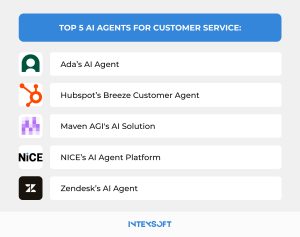
The process is straightforward. Teams teach the agent to sift through incoming messages, tag each one, and then pull the trigger on the right workflow – no human hand is needed. Say a user’s locked out: the agent swoops in, resets the password, and closes the case – all on its own.
But the automation goes beyond. If a customer asks to upgrade – say, to add more seats – Breeze can initiate that transaction and then trigger internal actions: push notifications to Slack, updates to CRM entries. It’s a sequence that mimics real-time human decision-making, but with greater speed and consistency.
HubSpot claims that 95% of its users find the AI tools easy to implement. That number, while unverified by independent audits, has been consistent in customer-facing materials and user feedback forums.
What sets Breeze apart isn’t just its functionality – it’s the tight integration with HubSpot’s CRM and marketing ecosystem. For users already embedded in HubSpot, deploying Breeze isn’t a question of strategy. It’s logistics.
The Canadian company says the tool delivers “instant, proactive, personalized, and effortless support.” Behind that language lies a GPT-based system capable of carrying multi-layered conversations, interpreting sentiment, and adjusting on the fly.
This system surfaces trending topics and flags problem areas. You can simulate test conversations, guide agent behavior with rule-based coaching, and build in complex logic, like processing returns or issuing credits.
There’s scale too. Ada’s agent supports 50 languages and offers behavioral targeting. This is a sharp pivot away from passive bots.
AI agents use segmentation to personalize by location, status, or channel – across SMS, voice, chat, and email – powered by customer profiles and behavior.
When action is required, Zendesk’s AI handles it autonomously – think: purchasing concert tickets, firing off a receipt, and updating the backend order system. It adapts mid-conversation, pings other systems for data, and responds in fluid, natural language.
For support agents, the Co-Pilot feature is where things really level up. It guides humans through live interactions, predicts customer behavior, and can suggest – or even complete – tasks. Bullet points typed by a rep are transformed into polished, on-brand responses in seconds.
Maven’s agent guides users to answers, takes autonomous action on behalf of customers, and escalates to human agents only when required. In a hotel booking scenario provided by the company, the agent changes a reservation in real time, then follows up – unprompted – by offering a spa package. It’s cross-sell logic.
Maven AGI’s system can upgrade accounts, modify license allocations, or execute workflows typically reserved for tier-2 or tier-3 support.
Maven AGI is backed by OpenAI, which has provided both technological access and industry credibility. Combined with its GPT-4 base, the platform is built not only to handle customer queries but to anticipate, adapt, and act – at scale.
The real innovation is in feedback and implementation. This platform runs predictive simulations based on internal data – then offers the option to accept, reject, or edit recommendations using natural language. If accepted, the change is rolled out instantly. Flows are updated. No tickets.
You need strategy and experience. You need a partner who understands not just the technology, but the consequences of rolling it out half-baked.
That’s where IntexSoft comes in.
It’s practice for us. Our teams have walked clients through every phase – from assessing readiness and defining workflows to training large language models and integrating them into CRM systems. IntexSoft knows where automation shines, where it fails, and how to blend machine learning with human insight to create systems that truly work.
So if your next step includes deploying a conversational AI customer service solution – or replacing static support with a smart AI customer service representative – then don’t go it alone. Contact IntexSoft’s AI customer service experts.


The article explores AI's impact on ecommerce, highlighting its role in enhancing customer experiences and driving revenue.

This article discover such questions as how AI technology is revolutionizing inventory management and accelerating business growth and how implementing AI solutions can streamline operations, optimize inventory levels, and improve forecasting accuracy.

In this article, we explore the patterns behind ecommerce vulnerabilities and how AI is redefining both risk and protection.