

Let’s break down how automated builds are rewriting the rules of modern development – and why not automating might be the most expensive mistake your tech team is making. Need more? Contact IntexSoft anytime.
Reading time: 15 min.
Welcome to the part of software development no one brags about in interviews: the build. Not the headline-grabbing code. Not the elegant UX. We’re talking about the gritty, behind-the-scenes mechanics that decide whether your app ships in minutes – or not.
Build automation is the practice of using scripts or tools to compile code, run tests, package binaries, and deploy applications – without a human pushing every button. In other words, it’s the shift from “Did you run the tests yet?” to “The pipeline already caught that bug.”
What is build automation? It’s the process of automating the creation of a software build and the associated activities – like compiling source code, running automated tests, generating documentation, and deploying to staging or production environments.
Instead of devs manually compiling their projects, setting environments, or executing test suites, build automation software handles all of it. Whether it’s a Makefile from the ‘70s or a cutting-edge CI CD automation pipeline running on GitHub Actions or Jenkins, the goal is the same: streamline the road from code to product.
For example, a developer commits code to the repository. The build automation tool (let’s say Jenkins) detects the change, triggers a build script, compiles the code, runs unit tests, and deploys the app to a test server – automatically, silently, and flawlessly (ideally).
Build automation is what keeps Continuous Integration moving, ensuring that every change is quickly verified and merged with the main branch several times a day.
With automation, feedback loops are tighter, errors are spotted earlier, and deployment becomes a repeatable, reliable ritual – not a gamble.
Still building manually? You’re wasting time, introducing bugs, and betting against scale. Manual build processes are fragile. They’re inconsistent. And they don’t scale beyond a couple of devs before things start breaking in bizarre, untraceable ways.
Automation, on the other hand, is:
Why automate?
In this article by IntexSoft, we dig deeper into what build automation really is, explore the tools and technologies behind it, and explain why it’s absolutely crucial for modern DevOps environments.

There are several principles of smart development that every C-level executive should consider:
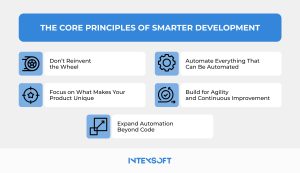
In tech, time is currency – and nothing burns it faster than ego-driven engineering. Somewhere between your third rewrite of a logging utility and a bespoke build script that breaks every Friday, you’ve forgotten one of the golden rules of modern development: if it already exists, use it.
Reinventing the wheel is inefficient with a nice Git history. The open-source ecosystem is stacked with tools that already solve the problems you’re wasting cycles on. Need continuous integration? Jenkins, GitHub Actions, GitLab CI. Need package management? Poetry, pip, npm, done. You’re not in a void. You’re standing on the shoulders of thousands of developers who solved this yesterday.
And in the age of continuous automation, every minute spent duct-taping together your own brittle system is a minute not spent delivering value, improving UX, or, let’s be honest, closing the Jira ticket that’s been haunting you since Q2.

Manual steps are not for your deployment pipeline.
If a process can be scripted, templated, or scheduled, it should be. Why? Because humans forget things. They mistype commands. They deploy to prod instead of staging because they had five browser tabs open and didn’t double-check the terminal. Automation doesn’t do that. It doesn’t get tired. It just runs – consistently, reliably, and at scale.
In modern DevOps, you automate your builds so you can catch errors before they hit production. You automate tests so you can trust your code won’t implode. You automate deployment so that going live doesn’t require six Slack approvals.
Ever wonder what is continuous build? It’s the practice of automatically compiling and testing code every time a change is made. It’s the foundation of a development pipeline that never sleeps – and never slips.
Every manual task in your stack is a liability – a hidden tax on your team’s time and sanity. Automation turns those liabilities into leverage.
And here’s the kicker: the more you automate, the faster you move. The faster you move, the more you ship. The more you ship, the more you learn – and win.
Let’s get one thing straight: your customers aren’t sticking around because your team wrote a custom build script in Bash. They’re here for what only you can offer – your product’s unique value, your insight, your edge. So stop burning hours perfecting infrastructure that someone else has already solved better. That’s not innovation.
This principle hits hard. Why are you managing servers manually when container orchestration is a solved problem? Why are you writing deployment pipelines from scratch when proven CI/CD templates exist for every stack?
Let automation handle the heavy lifting – testing, compiling, deploying – so your team can double down on what actually differentiates your product in the market.
Because in today’s saturated digital economy, the only thing worse than falling behind is working hard on the wrong thing.
The myth of the “perfect build” needs to die. In modern software development, perfection is a bottleneck. If you’re waiting to ship until every corner is polished, your competition is already halfway through their next sprint.
Agility is embedded in your build automation software strategy. It’s in the way your team merges small changes fast. It’s in how feedback loops get tighter, iterations move quicker, and errors become opportunities instead of outages.
Build automation tools give you that speed. They make rolling out updates as routine as a Git commit. You can test, validate, and ship continuously – not quarterly. And the best part? Every improvement you make feeds back into the cycle. Today’s bug fix is tomorrow’s best practice.
Build systems aren’t static – they’re evolving organisms.
You’re automating tests. You’re automating builds. Maybe you’ve even nailed down automated deployments. Good. Now go further.
Smarter development is about treating the entire software lifecycle as a system ripe for automation. The real win? Pushing automation beyond the boundaries of engineering.
Think of compliance checks that run themselves. Think infrastructure spun up and torn down with a single YAML file. Think release notes auto-generated from Git commits, Slack messages triggered by deployment status, and dashboards that light up before you even know something broke.
The smartest teams are using automation to orchestrate the invisible work: provisioning cloud resources, monitoring logs, rotating secrets, syncing product docs. They’re building a self-aware machine that builds, ships, and protects itself.
Why does this matter? Because every manual task your team touches is a risk. It’s a potential failure point. Automation doesn’t just make life easier – it makes your systems resilient, repeatable, and predictable.

How to craft a responsive, intelligent pipeline that knows when to trigger, how to test, what to package, and exactly what to report? From the first commit to the last artifact, every step matters.
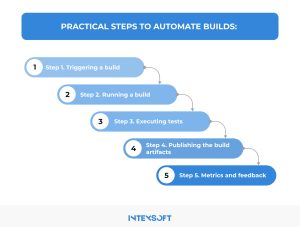
It all kicks off with the trigger. A build can’t run itself (yet), but it should know exactly when to wake up and go to work.
Think of triggering a build like a digital reflex: commit code to your main branch, push to a feature branch, open a pull request – the system reacts. Modern CI tools like Jenkins, GitHub Actions, GitLab CI/CD, or CircleCI listen for these cues and fire off builds in response.
Developers should write code, hit push, and watch the machine kick into gear. A properly configured trigger removes the lag between innovation and validation.
Once triggered, the build system shifts from passive listener to full-on factory mode. We’re talking compile, test, lint, package – the whole assembly line, fired up in milliseconds.
This is where build scripts take center stage. Tools like Make, Gradle, Maven, npm, or custom Python scripts choreograph the sequence. One command, dozens of steps. It’s testing assumptions, catching bugs, enforcing standards. The build system becomes your toughest reviewer and your most loyal teammate.
The real power lies in repeatability.
Automating your build isn’t worth much if the code it delivers is broken. That’s why test automation is the first battlefield. Once the code hits the repository, continuous integration (CI) services like GitHub Actions, Jenkins, or CircleCI jump in, running suites of unit, integration, and even end-to-end tests. The goal is to fix the obvious regressions before they reach staging.
But modern automation doesn’t stop at “green or red.” Smart pipelines parallelize test jobs, run them in isolated containers, and auto-categorize failures using machine learning models trained on test history. Flaky tests? They get flagged.
Passing tests isn’t the finish line – it’s the launchpad. The next practical step is publishing the build artifacts, and it’s where automation meets logistics. The pipeline must deliver artifacts to a defined destination – fast and consistently.
Use tools like Docker, JFrog Artifactory, or AWS CodeArtifact to store build outputs in centralized repositories. Tag artifacts with metadata: commit SHA, branch name, build timestamp. It powers traceability. And in production incidents, being able to reverse-engineer exactly what was shipped is what guarantees resolution.
Versioning? Automate that too. Semantic versioning is nice in theory – CI pipelines make it real, auto-incrementing builds based on branch type or commit message flags. It’s shipping with structure.
If you can’t measure it, you can’t improve it. The final step is to set up a feedback loop that watches the build automation process.
Track build duration. Monitor test flakiness. Analyze deployment frequency. Pull this data into dashboards using Prometheus, Grafana, or even simple Slack bots. Because feedback loops are what make automation evolve. Think of it as telemetry for your development culture.
Smart organizations take it further. They use machine learning to forecast build failures. They correlate code churn with deployment success. And they treat build metrics not as passive charts – but as triggers for future automation steps.
And if you’re looking for a partner to help orchestrate all of this? IntexSoft has you covered. From custom CI/CD pipelines to intelligent DevOps for automation strategies, we bring the tools, talent, and expertise to turn your development workflow into a well-oiled machine. Because great software is engineered to evolve.
Contact us anytime.


Blockchain technology is revolutionizing the ecommerce industry, providing increased security, transparency, and efficiency for online transactions. In this article, we discover how businesses are leveraging blockchain to streamline operations and build trust with customers.

The conversation around blockchain and databases has been going on for a long time, but not everyone understands what it is and how to work with it. That's why we have decided to explain everything in simple words and sort the key concepts out.

Let’s explore the latest trends and predictions for software development in 2025. Stay ahead of the curve with insights on emerging technologies and industry shifts.