

Discover how much companies really spend on SaaS – and why that investment may not always deliver the best value. IntexSoft breaks down the key differences between off-the-shelf tools and Python-based solutions, showing how a custom approach can be more cost-effective and efficient. You’ll also get practical guidance on how to get started with Python integrations.
Reading time: 14 min.
Your tech stack is quietly bleeding you dry.
Three years ago, the average company shelled out around $3,500 per employee per year on SaaS (Software as a Service) tools, according to data from procurement platform CloudEagle. That number? It’s only going up. Fast. And here’s the kicker: most businesses have no idea where half that spend is going — or why. SaaS spend management is broken, and it’s costing more than you think.
SaaS was supposed to save us. It promised leaner operations, quicker rollouts, and fewer 2-year procurement cycles with six layers of approvals. But now, it’s quietly become the third-largest expense on many company budgets — trailing only behind salaries and office space. If you’re not actively working to manage SaaS spend, you’re likely overspending without realizing it.
Thank the pandemic for kicking the SaaS addiction into overdrive. Businesses scrambled to stay online. Then came AI — feeding the fire with subscription-based copilots, text generators, and automation tools promising 5x productivity. Tools got easier to buy. And finance teams lost the plot.
Employees armed with corporate credit cards began signing up for everything: a CRM here, a design suite there, a data dashboard, and a Zoom plugin that writes your meeting notes. SaaS made it too easy. No RFP. No, IT gatekeeping. Just log in and swipe.
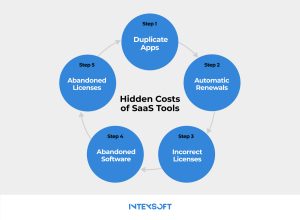
That kind of frictionless adoption comes with a price: SaaS portfolios ballooned to 50 – 70 apps per company — even in startups with fewer than 100 people. Annual costs? $250K to $1M, in many cases.
SaaS tools were meant to solve problems. However bloated portfolios often create new ones. Redundant apps. Unused licenses. Surprise renewals are buried in the fine print. Teams spinning in circles because five different tools claim to do the same thing — none of them integrated.
Most businesses are still trying to track all this with a spreadsheet. Meanwhile, over 30% of SaaS licenses go unused, according to Gartner.
Here’s what savvy teams are doing: skipping the SaaS glut and solving problems at the code level. Increasingly, companies are turning to Python as a leaner alternative — building custom tools that do exactly what’s needed, minus the $499/month subscription traps. This shift doesn’t just simplify workflows—it slashes your SaaS budget without compromising functionality.
In this article, IntexSoft is diving deep into Python’s cost-cutting superpowers.
As we mentioned above, when it comes to stitching software together, every new app, platform, or SaaS tool promises to solve one tiny problem — until you have 80 of them, none talking to each other. That’s where Python comes in: smarter, faster, and way more elegant than whatever bloated integration platform you’re duct-taping together right now.
Forget expensive middleware and rigid APIs with five-step authentication handshakes.
But why does Python dominate the integration game? Let’s break it down into six key reasons:
Whether you’re scaling a startup or unblocking an enterprise team, Python turns fractured workflows into clean, connected systems.
Python owns automation. Here’s where it shines hardest:
| Use Case | What It Solves | Why Python Wins | Example |
| Automating Repetitive Tasks | Manual, time-consuming tasks that drain productivity | Lightweight scripts that run fast, consistently, and without ongoing license fees | Automatically pulling reports, renaming and organizing files, scheduling data syncs |
| API Integrations | Broken or rigid tool connections between platforms | Flexible handling of any API structure with libraries like requests, httpx, or aiohttp | Connect Stripe → Slack → HubSpot → Notion in one seamless chain |
| Data Analysis & Reporting | Fragmented data sources and limited business intelligence | Rich data handling and custom visualization tools (pandas, matplotlib, seaborn) | Merge support ticket data with product usage to predict churn |
| Replacing Workflow Tools | Overpriced automation platforms with usage-based fees and poor customization | Full ownership of your automation logic and logic routing at scale (FastAPI, Celery, Airflow) | Build a lead qualification pipeline that routes hot leads via email, Slack, and your CRM |
Now that we’ve shown how Python is reshaping the way companies build, scale, and secure their digital workflows, let’s explore the top advantages your business can gain from the power of this language.
Here’s why the savviest teams are betting big on Python-based approaches:
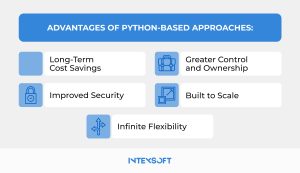
SaaS might seem cheap, until the invoice lands. Every seat, every user, every “premium” automation adds up. Python flips the script. Write it once, and run it forever. No surprise billing. There are no feature paywalls. Just lean, purpose-built code that does exactly what you need.
Example: Instead of paying $500/month for a report automation tool, a Python script built in-house does the job at zero ongoing cost.
With SaaS, you’re renting someone else’s vision. With Python, you’re building your own. You control the data. You define the logic. You own the stack. And when your business evolves, your code evolves with it, without waiting on a vendor’s roadmap.
Why settle for “good enough” when you can build “perfect for us”?
Security isn’t one-size-fits-all. Off-the-shelf tools can become blind spots — exposing your data to unnecessary third-party risk. Python-based solutions let you decide where and how your data flows. You don’t just patch vulnerabilities, you prevent them by design.
Fewer moving parts means fewer attack surfaces.
SaaS platforms break when your business grows fast. Python doesn’t. You can scale horizontally, vertically, or diagonally—because you’re not trapped inside someone else’s system limits whether you’re handling a thousand API calls or a million, Python’s ready.
One codebase can take you all the way.
Need a Slack bot that pulls data from your CRM, cleans it, generates a PDF, and posts it on Notion every Friday? There’s no SaaS tool for that, but you can build it in Python by Monday.
With Python you own your logic, command your tools, and never pay for complexity you don’t need.
Consider Python as a smarter, leaner, more controlled way to run your business.
Here’s how to replace Software-as-a-Service bloat with a Python-powered setup that actually fits your workflow, and your budget.
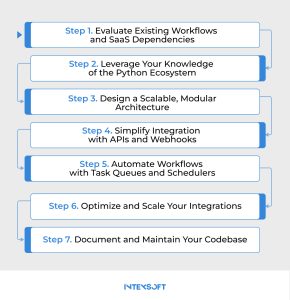
Start by mapping out what your team actually uses. Not just what’s installed, but what’s actively delivering value. Remember, if you’re using more than 50 tools, you’re already losing money.
Python open-source community has built packages for nearly every integration task imaginable: CRM syncing, email parsing, invoice automation. No need to build from scratch. Use what’s already out there.
Think like Lego. Don’t try to build a monolith that does everything—build small, reusable components. Python’s modular nature means you can start with a single script and scale to an entire infrastructure without redoing everything.
Most SaaS platforms expose their guts through APIs. Python makes talking to them feel like casual conversation. No bloated dashboards, no opaque automation builders. You control the logic, the flow, and the response.
Want daily Slack alerts from your database? Auto-tag support tickets from emails? Python + tools like Celery or APScheduler get it done. The difference? No hidden “Pro Plan” fees. No limits on how many flows you run.
Start small, but think big. Use logs to see what’s working, identify slow parts, and optimize. As your business grows, your code grows with it. Unlike SaaS tools, you’re not stuck waiting for feature rollouts. You build what you need, when you need it.
The biggest myth: Python-powered workflows are messy. Not if you document them.
Use simple READMEs, flowcharts, or inline comments to make your code transparent, even to non-tech stakeholders.
Somewhere between your fifth Slack integration and the seventh analytics dashboard, your tech stack stopped serving your team and started running the show. That $500/month subscription you forgot to cancel? It’s just the tip of a very bloated iceberg.
With the right libraries, the right architecture, and the right team, Python delivers exactly what your business needs, no more, no less.
But here’s the kicker: you don’t have to go it alone.
If you’re ready to swap vendor lock-in for clean, customizable code, IntexSoft is the team to call. With years of deep experience in building Python-based solutions, we design scalable systems that match your workflow.
Because in a world flooded with plug-and-play platforms, the smartest move might just be writing your own playbook.
Contact IntexSoft for a free consultation.


Thinking about a multi-cloud strategy? It’s not all smooth sailing—there are big wins, but also real challenges.

This guide explores the differences between on-premises and cloud databases, helping you make informed decisions for your data storage needs. In this article, we discuss the benefits and challenges of each option to find the best solution for your business.

In this article, you will explore all the essentials of cloud computing: its types, top examples, benefits, and implementation practices.