

Digital currency NFT has sparked enthusiasm and skepticism in the online store economy. But what do they really offer for e-commerce? This article explores their key advantages, the industries adopting them, and the challenges ahead. Need a deeper dive? Our experts are available for consultation.
Reading time: 10 min.
Most e-commerce brands don’t think about NFTs. Some haven’t even heard of them. Yet, in a world where digital ownership is rapidly evolving, ignoring this shift could mean missing out on an opportunity.
NFTs (non-fungible tokens) are a new kind of asset, a way to assign tangible value to digital goods.
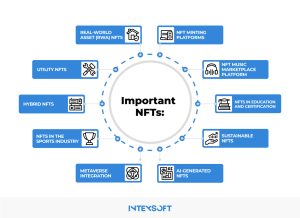
NFTs are digital assets that cannot be duplicated, counterfeited, or replaced. They exist on the blockchain, offering proof of ownership and authenticity. At first, they gained traction in art, gaming, and collectibles. But e-commerce brands are starting to take notice. And we will show all the essentials below.
But now let’s concentrate on what has changed:
The numbers back this up: by 2025, the NFT market is projected to generate $608.6 million in revenue, with an estimated 11.64 million users globally. The United States alone is expected to lead, reaching $115.2 million in revenue that year.
For online retailers, the implications are significant. Digital products (once seen as intangible) can now carry real, tradeable value. A limited-edition design, a premium service, even access to an exclusive online community, paired with an NFT, these offerings become more than just files on a server. They become assets. And consumers are willing to invest.
According to Statista, the average revenue per user in the NFT market is expected to hit $52.3 in 2025, underscoring just how much people are spending to own digital goods.
The NFT eCommerce market isn’t without its risks. Environmental concerns tied to blockchain energy consumption remain unresolved. Speculation drives prices in ways that aren’t always sustainable. Some brands will cash in, others will flame out. But the trajectory is clear: digital ownership is being redefined. E-commerce brands that recognize this shift early will be better positioned.
| Benefit | What It Means for E-Commerce | Why It Changes the Game |
| Verified Ownership and Authenticity | Blockchain-backed proof of ownership eliminates counterfeit goods and verifies product authenticity. | Fraud gets harder. Trust gets stronger. Every transaction becomes traceable, every product provable. |
| Elevated Customer Engagement | NFTs turn passive buyers into active participants. Exclusive digital perks, VIP access, and personalized rewards redefine brand loyalty. | The sale is the beginning of an ongoing relationship—where customers stay engaged long after checkout. |
| New Revenue Opportunities for Creators | Secondary market sales send royalties back to the original brand, ensuring long-term profit from each product’s lifecycle. | Instead of losing value over time, products generate continuous revenue. The ledger never forgets. Neither should businesses. |
| Building Consumer Trust Through Transparency | Full visibility into a product’s origin, ownership history, and lifecycle is now possible. Buyers know exactly what they’re getting. | In a market filled with skepticism, transparency is survival. |
Let’s focus on three of the most ubiquitous examples.
E-commerce thrives on exclusivity, and NFTs offer a new way to define it. The key isn’t the token itself. It’s what it represents. Consider this: a high-end sneaker brand doesn’t just sell shoes—it sells status. Now imagine every limited-edition release coming with a corresponding NFT, a verifiable, tradable certificate of authenticity.
The implications are clear. Counterfeiting becomes more difficult. Resale markets become more transparent. And, crucially, the relationship between buyer and brand extends beyond the point of purchase. It’s no longer just a product. It’s an asset with a traceable history and provable value. With an NFT ecommerce platform, brands can seamlessly authenticate and verify ownership, adding an extra layer of trust and exclusivity.
Loyalty programs are predictable. Earn points. Get a discount. Repeat. NFTs introduce a dynamic shift. A discount tied to an NFT is a tradeable, resellable asset. A buyer who owns the NFT gets privileged pricing. But if they no longer need the product? They can sell the NFT, passing that discount to someone else.
For e-commerce brands, the advantages are undeniable. Customers become brand advocates. Discounts become long-term incentives rather than short-term perks. And every transaction—every trade of that NFT—keeps the brand in circulation, creating ongoing organic marketing. Businesses partnering with an ecommerce NFT platform development company can leverage blockchain technology to develop and integrate such dynamic loyalty systems, ensuring long-term customer engagement.
Here’s the scenario: a consumer buys an expensive smartwatch. The brand offers a lifetime warranty. But tracking that warranty? A logistical nightmare. Enter NFTs.
A warranty tied to an NFT isn’t just a document—it’s proof of ownership, maintenance history, and coverage, all verifiable on the blockchain. If the customer sells the product, the warranty transfers with it. No paperwork. No disputes. Just a seamless, transparent record.
Car manufacturers could use this system. So could luxury appliance brands. Even digital services. The principle remains the same: move beyond traditional receipts and paperwork. Shift to a decentralized ledger that eliminates ambiguity and ensures trust.
Customer loyalty is no longer about points and discount codes. NFTs allow brands to offer exclusive access to virtual events, special-edition products, and personalized digital experiences.
Retailers experimenting with NFTs are seeing a measurable increase in consumer engagement. Early adopters report a boost in sales and brand visibility. The reason is that buyers seek out limited-edition digital collectibles and blockchain-based rewards. Industry experts suggest that by 2026, NFT-driven gamification could account for a significant portion of online retail revenue, particularly in the luxury and fashion sectors.
For decades, resale markets have thrived without returning profits to the original creators. But blockchain technology is changing that. With NFTs, brands—from luxury fashion houses to digital artists—can now collect royalties every time a product is resold. Companies that adopt an ecommerce NFT marketplace are actively exploring the potential of smart contracts, ensuring automatic royalty payments long after the initial sale.
As augmented reality (AR) and virtual reality (VR) gain traction, NFTs will serve as the bridge between digital and physical commerce. Virtual storefronts in the metaverse will allow users to “try on” NFT-based clothing, test out digital home decor, or even purchase land in virtual worlds. Brands are already experimenting with metaverse fashion, and as these technologies become mainstream, ecommerce NFT platforms will be critical in enabling seamless integration.
At IntexSoft, we’ve been watching the NFT space closely—as a company invested in the future of e-commerce. We believe NFTs have the potential to upend how digital sales function.
Right now, SKUs—the backbone of inventory management—are static. They exist as isolated records in databases, disconnected from the products they represent. NFTs change that. A blockchain-based SKU is a dynamic, traceable, and verifiable record of a product’s history, from manufacturer to final owner.
For brands, this is a business model shift. A limited-edition drop is an opportunity to create permanent, authenticated ownership records—impossible to forge, impossible to manipulate. Resale markets become transparent. Counterfeit detection becomes automatic.
The profit-sharing model shifts, too. Emerging brands—struggling against industry giants—suddenly have a new tool. With NFTs, every resale, every trade, every secondary market transaction can funnel royalties back to the original creator. A designer selling directly to consumers today could still profit from that same item years later. The ledger doesn’t forget.
In a traditional e-commerce model, product data ends at the point of sale. After that? It’s a black hole. NFTs rewrite this equation. Every stage of a product’s life—ownership, resale, repair, and even modifications—can be recorded on the blockchain.
At IntexSoft, we’re building for it. If you’re ready to explore how NFTs can future-proof your business, let’s talk.
The consultation is free.

The article explores AI's impact on ecommerce, highlighting its role in enhancing customer experiences and driving revenue.

Discover the essential reasons why ecommerce businesses should have chatbots. From improving customer service to increasing sales, find out how chatbots can revolutionize your online store.

This article highlights the significance of integrating the best marketing automation for ecommerce. It covers how ecommerce business owners can benefit from the right marketing automation solution.