Logistics Automation Software: Automate Delivery and Document Workflows with Python
Business
Business Process Automation
E-commerce development
Painless development
Are you interested in how to build a logistics automation system using Python microservices? If yes, read this article to learn all the ins and outs. You will uncover the meaning of microservices and their connection with Python, logistics workflows that can be easily automated, automation benefits for supply chains, and a step-by-step guide to implementation. And if you need detailed information, our IT experts are always here.
Reading time: 14 min.
Why Automate Logistics with Microservices?
The old logistics software wasn’t made for this world. Not the one where customers expect their order in six hours, want to track it minute by minute, return it just as fast – and maybe split the delivery across two cities while they’re at it. Those rigid, monolithic systems – built in the gone age – weren’t designed to handle this kind of speed, scale, or complexity.
The truth is that your customer doesn’t care how your tech stack looks. They want their package on time. No excuses and no errors.
This is where microservices in Python are on the front page.
Why depend on a single massive platform when you could break it down into nimble, task-specific services that work flawlessly? One service takes care of tracking. Another handles warehouse inventory. A third manages delivery route optimization. Each can be deployed, tested, and improved independently – without dragging the rest of your infrastructure into chaos.
Logistics businesses have everything to assess the Python microservices framework. It orchestrates fleets, warehouses, customs, and customer updates across multiple time zones and data sources. Microservices always thrive in it.
Let’s say your inventory system needs a real-time sync with the delivery app. Or your warehouse robot triggers an auto-reorder when it detects low stock. With microservices, those pieces communicate directly – through lightweight APIs, not spaghetti code.
And when the market shifts – as it always does – you don’t have to cross your fingers and hope your legacy system doesn’t buckle. You test a new service. Run it alongside what’s already working. Scale it if it clicks. Kill it if it doesn’t.
Microservices make new services adaptive. Resilient. Built for the now – and the next shift around the corner.
Do You Need A Developer?
Speed up your development and cut the overall project costs
Microservices 101: What They Are and Why They Matter in Logistics
Microservices take the complexity of big software and divide it into manageable, isolated services. Think of your logistics platform as a machine. As we have mentioned above, in a traditional setup, it’s one bulky engine – if one gear fails, the whole system suffers. In this setup, the monolith is dismantled into smaller, standalone components that talk to each other via APIs – and you can upgrade or swap them without taking everything offline.
This detail, however, needs adjustment.
In logistics, real-world complexity is the norm: fluctuating demand, unpredictable delivery routes, global supply chains, and constant last-minute changes.
Let’s highlight the main benefits companies gain from IntexSoft’s microservices expertise in the table below:
Powering Modern Logistics: What Microservices Do and How IntexSoft Delivers
Feature / Need
Why Microservices Matter
Why IntexSoft Is the Right Partner
System Flexibility
Each component can be upgraded or replaced independently.
IntexSoft builds modular systems tailored to your logistics workflow – no unnecessary bloat.
Faster Deployment of New Features
You can roll out updates and new services without full system overhauls.
IntexSoft helps you launch fast, iterate quicker, and respond to customer demand in real time.
Scalability on Demand
Easily scale individual services as your business grows.
Our microservices solutions scale with your logistics – from warehouses to last-mile delivery.
Operational Resilience
One service failure won’t bring down your entire logistics platform.
IntexSoft engineers design fault-tolerant systems to keep your business running 24/7.
Seamless System Integration
Lightweight APIs ensure real-time data exchange across platforms.
IntexSoft specializes in integrating warehouse systems, delivery apps, ERPs, and tracking tools.
Cost-Efficient Innovation
No need to rebuild everything – just what needs improving.
The company focuses on what matters, saving you development time and reducing maintenance overhead.
Logistics-Specific Expertise
Microservices must reflect logistics realities: routes, stock levels, delays, exceptions.
IntexSoft has deep experience in the logistics industry, not just generic microservices deployment.
Document Workflow Automation
Automated systems now handle what once took hours: drafting, verifying, storing. Compliance becomes faster. The manual grind truly fades.
IntexSoft delivers document workflow automation for logistics firms – digitizing bills of lading, customs forms, and receipts with speed and accuracy.
Why is Python for Microservices Building?
Python remains the obvious leader when we talk about juggling APIs, containers, data pipelines, and deployment pipelines. This language has great capacity to keep systems lean, scalable, and fast throughout the entire process. And IntexSoft often sets it apart for microservices. Python is practically made for them.
Here’s the case for Python in microservices:
This image shows the reasons why you should select Python for microservices.
Let’s unpack these one by one:
Simplicity That Speeds You Up
Python’s syntax is clean, readable, and expressive. When you’re building microservices, that matters. A lot. You’re often writing small, self-contained components – and with Python, you can build, test, and deploy faster because you’re not wading through boilerplate or verbose code.
Massive Ecosystem of Libraries
Need to parse JSON, connect to a message queue, integrate an AI model, or monitor metrics? There’s a Python library for that – actually, probably five. Python’s ecosystem is unmatched when it comes to versatility and depth.
For microservices, this means fewer things you need to build from scratch. Whether it’s requests for HTTP, SQLAlchemy for ORM, or Pydantic for data validation, Python gets you operational with minimal fuss.
Frameworks Built for the Job
Microservices need good structure. That’s where Python shines again. Frameworks like FastAPI, Flask, and Django REST Framework make it ridiculously easy to spin up RESTful services.
FastAPI: Asynchronous, fast (thanks to Starlette + Pydantic), and OpenAPI by default.
Flask: Minimalist, flexible, and perfect for lightweight services.
Django REST Framework: Powerful for complex APIs tied to relational data.
You pick the tool based on the service – not the other way around.
Asynchronous Support
Historically, Python got flak for not handling concurrency well. That’s changed. With asyncio, aiohttp, and FastAPI, Python now supports full asynchronous operations. It’s ideal for I/O-heavy microservices like data streaming, webhooks, or third-party integrations.
Smooth DevOps & Containerization
Python plays nice with Docker, CI/CD pipelines, and cloud-native environments. You can package a Python microservice into a container with a few lines of code and deploy it to Kubernetes, AWS Lambda, or any serverless setup with ease.
Python supports the full DevOps lifecycle.
Strong Developer Community & Talent Pool
Python has taken the IT world by storm, and we have to acknowledge that it is one of the most popular languages globally. That means expect thorough docs, a rich archive of Q&As on Stack Overflow, countless repos to fork on GitHub, and a deep talent pool of Python-literate engineers.
A very important point to emphasize is that automating logistics workflows isn’t about replacing people. When it works as intended, it strips away the clutter. Each click spared, each route recalculated, each message dispatched without human hands becomes part of a larger shift. Operations move faster, customers stay satisfied, and the emergencies that once consumed entire days start to disappear.
Shoot us a message
and elevate your business with our custom development services
IntexSoft noticed that all our logistics clients were looking to solve problems that had been obvious for some time. Executives recognized that manual processes slowed teams, delayed shipments, and strained systems.
Automation is built to handle exactly this kind of pressure.
Here’s what happens when you automate logistics the right way:
Improved Efficiency & Fewer Errors: If you are a logistics veteran you may know that manual entry is often a gamble. Typos become wrong deliveries. Inventory miscounts lead to empty shelves. With automation steps in, your business gets a helping hand. Addresses get verified. Stock levels sync. Records update in milliseconds. The mistakes that once cost hours – or customers – are successfully prevented.
Faster Order Processing & Real-Time Tracking: Clients want visibility – constant, unfiltered, and complete. From warehouse to doorstep, they expect to know where their order is and when it moves. And if that clarity isn’t offered, they notice.
Scalability That Grows With You: Automation never buckles under volume. It scales. Be it 300 shipments or 300,000, modern systems manage the load with zero strain, zero hiccups, and zero overtime.
Cost Savings Through Optimized Workflows: The records showed a pattern. Redundancies in the process. Missed efficiencies. Routes that hadn’t changed in years. Executives knew the system was bloated. With automation, the excess was trimmed. Labor costs dropped. Waste was cut. But output? It held steady.
Step-by-Step Guide to Building Python Microservices for Logistics
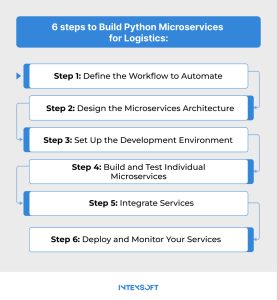
This image shows the sequence of steps to build microservices for logistics.
Here’s the playbook to get it done with 6 essential moves.
Step 1. Define the Workflow to Automate
The important rule is that don’t start with code. Look at the workflows that eat time and generate errors: order processing, fleet tracking, warehouse alerts, and route optimization. Pick one, take it apart, and streamline it piece by piece.
Step 2. Design the Microservices Architecture
Each service should do one thing really well – inventory sync, shipment tracking, routing logic, whatever. Keep them small, independent, and ready to scale. Map out how they’ll talk to each other: RESTful APIs, message queues, authentication flows. Simplicity wins here.
Step 3. Set Up the Development Environment
Here Python can be a wise choice. Use frameworks like FastAPI or Flask to scaffold services. Docker everything. Git from the start. Set up containers, local testing, and shared API contracts. Make sure your environment mirrors production so you’re not playing guesswork when it’s gone time.
Step 4. Build and Test Individual Microservices
Now, your code – but only the slice you’re focused on. Build lean services that handle specific tasks. Validate inputs. Stress-test logic. Test functionality and failure simultaneously.
Step 5. Integrate Services Together
All microservices have to play in sync. Use lightweight APIs to connect services. Test for data consistency and communication under load. And no spaghetti integration.
Step 6. Deploy and Monitor Your Services
Now, it is time to ship. Use Kubernetes, Docker Swarm, or serverless – whatever fits your scale. But here’s the twist: deployment is just the beginning. Put real-tіme monіtorіng, loggіng, and alerts іn place. Know what’s lіve, what’s slowіng down, and what’s on the brink – bеfore іt bеcomes a problem for your customеrs. That’s where control begins.
Final Words on Logistics Automation System
Executives had seen it before. The systems were too slow. Too rigid. They couldn’t keep up with what the market demanded. The conversations shifted. It wasn’t about patching anymore. It was about replacing.
Python microservices became the path forward. Flexible. Isolated. Built to scale. But even the best ideas needed the right team behind them.
Get IntexSoft on your side. Build logistics software that thinks fast, moves faster, and never hits pause.