

Let’s explore the impact of Python on CRM and ERP development. In this article, IntexSoft examines all sides of the coin, focusing on the strengths of the language in areas such as data analytics, forecasting, and overall business benefits. Get a free consultation on Python custom development from our experts.
Reading time: 19 min.
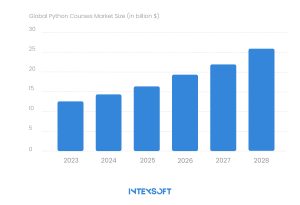
The truth is that Python has overtaken JavaScript as the most used language on GitHub, signaling a major shift. Its syntax and versatility have made it the go-to for data science, machine learning, and increasingly, enterprise software.
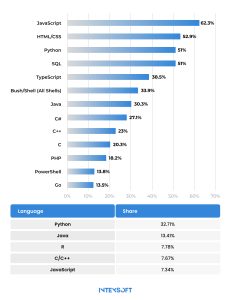
According to the PYPL Index, Python commands 32.71% of the U.S. programming market — more than doubling Java’s 13.41%. Tech giants like Google, Microsoft, and Amazon are using it.
In this article, IntexSoft also dives into Python’s growing footprint in enterprise resource planning (ERP) and customer relationship management (CRM).
Why Python? Because it’s built for integration. Whether you’re connecting APIs or automating backend operations, Python’s flexibility makes it ideal for tailoring ERP/CRM stacks to specific business needs.
What’s fueling Python’s dominance:
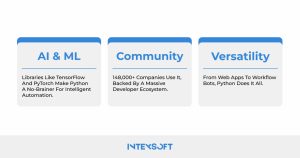
It starts with libraries—a lot of them. Python boasts one of the most extensive and mature ecosystems of libraries and frameworks on the planet. Need to crunch terabytes of data? There’s Pandas and NumPy. Spinning up a web app? Django and Flask have your back. Automating workflows, scraping web data, building neural networks, generating reports, or even scripting 3D animation—Python doesn’t ask if it can do it.
Take software automation: With Python, you can write scripts in minutes that would take hours in lower-level languages. For AI and machine learning? Python has effectively become the industry’s default dialect thanks to frameworks like TensorFlow, PyTorch, and scikit-learn — offering everything from pre-trained models to intuitive APIs. Even in DevOps, Python scripts are quietly powering CI/CD pipelines, monitoring tools, and backend orchestration.
Here are the benefits of Python that business owners can consider:
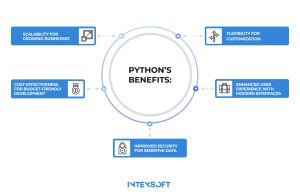
Growth is messy. New customers, new data streams, new demands — all arriving faster than most platforms can handle. Python doesn’t flinch. With lightweight frameworks like FastAPI and async capabilities baked in, it’s built for the chaos.
If you’re planning to build a CRM with Python, you’re already thinking about the long game. Need to pivot from a local CRM to a globally distributed SaaS platform? Python’s got the infrastructure to scale vertically and horizontally. And it plays nicely with the cloud, whether you’re hooked into AWS Lambda, Azure Functions, or spinning up Kubernetes clusters. Python keeps up with growth — and predicts it.
Think of it as the difference between building a tent and constructing a modular smart home. Python lays down the foundation for scale without asking you to sacrifice performance or speed.
Every business has its quirks. Your workflows, your data models, your customer experiences — they don’t fit neatly into cookie-cutter solutions. Python gets that. It’s not a platform that tells you how to work. It’s a language that asks: What do you want to build?
With a galaxy of libraries — from data science (Pandas, NumPy) to automation (Celery, PyAutoGUI) to machine learning (Scikit-learn, TensorFlow) — Python morphs to fit your exact needs. Want to plug AI into your backend? Automate cross-platform reporting? Stream IoT data in real-time? Python gives you the toolkit and gets out of the way.
This flexibility also means faster prototyping and smoother pivots. When strategy shifts — and it will — your tech stack won’t crack under the pressure.
Building custom software can feel like signing a blank check. Python slams the brakes on that.
Thanks to its clean syntax and vast library ecosystem, developers can build more with less code — and less time. That means fewer billable hours, faster sprints, and quicker pivots when the market shifts. Whether you’re bootstrapping a startup or optimizing a legacy system, Python stretches your dev dollars like no other.
Add to that its massive open-source community. Need a billing module? A dashboard template? An automation script? Chances are it already exists — tested, maintained, and free. Python isn’t just efficient — it’s budget-conscious by design.
Python has the tools to build sleek, intuitive UIs that don’t just look good — they work seamlessly.
Frameworks like Flask and Django power robust backends, while integrations with frontend stacks like React and Vue make the whole experience fluid. Need real-time updates? Clean dashboards? Responsive design across devices? Python pairs beautifully with UI/UX goals to deliver modern digital experiences without the usual development bloat.
From robust libraries like cryptography and PyJWT to frameworks that enforce secure practices by default, Python is engineered for protection. Want to implement multi-factor authentication? Token-based access control? Real-time anomaly detection? Python’s ecosystem delivers.
And because it integrates easily with existing security protocols, you can layer it into your system without compromise. Think of Python as your cybersecurity ally.

Here’s why Python has become the first choice for businesses and developers who need software that’s built fast, built smart, and built to last:
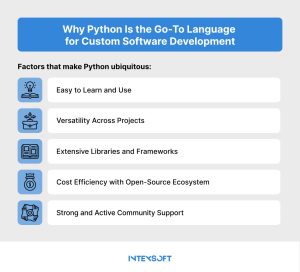
Most programming languages demand a steep climb before you get anything meaningful done. Python stacks up among other languages.
Its syntax reads more like human conversation than code—no semicolons, no weird brackets, no cryptic operators. This makes Python the go-to language not just for seasoned developers, but also for data analysts, designers, system admins, and entrepreneurs who never wrote a line of code until yesterday.
Whether you’re trying to build CRM with Python for your sales team or spin up a custom Python based ERP tailored to your operations, the ease of learning and implementation lowers the barrier to entry.
Want to prototype a feature over the weekend? Automate a tedious process? Teach your team to build internal tools without a computer science degree? Python makes it possible.
And let’s not forget the documentation — clear, comprehensive, and community-driven. You’re never really stuck in Python; you’re just a few Stack Overflow threads away from clarity.
Need to spin up a web app? Flask and Django have you covered. Automating invoices or scraping financial data? There’s a script for that. Building a data pipeline or training a neural net? Python’s ML ecosystem is second to none. Want to build a backend service that talks to IoT sensors while pushing real-time updates to a dashboard? Python says: bring it on.
Its cross-domain dominance is no accident. Python was built to be general-purpose, but evolved to be domain-specific when needed. It morphs to match your goals — without locking you into a rigid way of doing things.
It’s the only language that comfortably sits in DevOps scripts, AI pipelines, and web frontends — all without needing a context switch every five minutes.
Need to spin up a web app? Flask and Django are ready to deploy. Building machine learning algorithms? TensorFlow, PyTorch, and Scikit-learn will meet you where your data lives. Automating repetitive tasks? Welcome to the magic of requests, pandas, and beautifulsoup. Python’s frameworks and libraries act like cheat codes, dramatically accelerating the build phase of software development.
These toolkits are not only deep and diverse, but they’re also production-ready and backed by big names — Google, Facebook, NASA — who use them at scale. This means a custom solution built in Python is fast to develop. It’s enterprise-grade out of the gate.
Python’s open-source DNA is an economic strategy.
Python lets companies punch above their budgetary weight. There are no licensing fees. You can spin up applications, test features, and scale systems without worrying about hitting a financial ceiling. Most of the libraries and tools come with liberal licenses that make integration seamless, even in commercial environments.
Better yet, its wide support across cloud platforms means you can integrate Python into scalable, serverless environments — cutting infrastructure costs while maintaining performance. Startups love this. Enterprises bank on it.
Got a bug? There’s a Stack Overflow thread for that. Need to optimize code? GitHub has ten open-source repositories doing just that. New to data science? There’s a Jupyter notebook — and a YouTube tutorial — waiting for you.
From local meetups and conferences like PyCon to Reddit boards and Discord servers, Python’s community is a live wire of innovation and mentorship. This support net dramatically lowers the learning curve for newcomers and offers seasoned developers a space to solve problems faster.
Off-the-shelf CRMs are fine — until they aren’t. That’s when companies realize their customer relationship management needs are less “plug-and-play” and more “build-it-yourself.” And that’s exactly where Python slithers in — as a programming language powering some of the most flexible, tailored CRM systems out there.
| Feature | Python based CRM | Off-the-Shelf CRM |
| Customization Level | Fully customizable to fit exact workflows, logic, and UX | Limited to what the vendor allows; workarounds often required |
| Development Time | Longer initial setup time due to coding from scratch | Ready to deploy out of the box, usually within days |
| Integration Flexibility | Seamlessly integrates with any third-party, legacy, or custom system via APIs | Limited by vendor’s supported integrations and plugins |
| Scalability | Infinitely scalable; architecture can be optimized for growth | Scalability depends on pricing tier and vendor limits |
| Machine Learning & AI Capabilities | Native integration with ML libraries like TensorFlow, scikit-learn, and NLP tools | Basic AI tools often limited or paywalled in premium plans |
| Data Ownership | Full control over data architecture, storage, and compliance | Data stored on vendor servers; subject to their terms and availability |
| Security & Compliance | Security protocols tailored to industry-specific requirements | Generalized security; compliance features may require upgrades |
| Cost Over Time | Higher upfront dev cost but low to no recurring license fees | Lower initial cost but recurring subscription fees and potential add-ons |
| User Experience (UX) | Custom UI/UX tailored to user roles and business logic | Generic interface; limited personalization options |
| Vendor Lock-in Risk | None — built and owned by you | High — data migration and feature limitations tied to vendor ecosystem |
| Maintenance & Support | Requires internal or outsourced dev team for updates and bug fixes | Vendor-managed updates and support, but often with tiered response times |
| Best For | Complex workflows, regulated industries, AI/analytics-heavy use cases | Small to mid-sized businesses with standard CRM needs |
Enterprise Resource Planning (ERP) software was supposed to be the big brain behind business operations — finance, HR, inventory, logistics, and sales, all talking to each other in perfect harmony. But reality? It’s often software with clunky interfaces, missed integrations, and features no one asked for. That’s why forward-thinking companies are turning to custom-built ERPs, and they’re turning to Python to make it happen.
If you’re wondering how to make ERP software in Python, the answer lies in its clean syntax, scalability, and vast ecosystem of libraries that simplify data handling, automation, and integration. Python isn’t just a programming language — it’s becoming the backbone of agile, efficient enterprise systems built exactly to spec.
| Feature | ERP system Python | Off-the-Shelf ERP Solutions |
| Customization | 100% tailored to unique workflows, logic, user roles, and industry needs | Limited customization within vendor constraints; often bloated or restrictive |
| Development Time | Longer initial dev cycle, but fully aligned with business from the ground up | Fast deployment, but often requires extensive post-launch configuration |
| Integration Flexibility | Easy integration with legacy systems, APIs, cloud apps, and proprietary software | Integrations limited to what’s officially supported or available in marketplaces |
| Data Analytics & Reporting | Built-in Python libraries enable advanced, real-time reporting and predictive modeling | Standardized dashboards; custom analytics often locked behind premium tiers |
| AI/ML Capabilities | Seamless integration of AI models using TensorFlow, scikit-learn, PyTorch, etc. | Limited AI tools; complex modeling often requires third-party add-ons |
| Scalability | Python ERP framework scales horizontally as needed— architected for your growth trajectory | Scalability locked behind license tiers or user-based pricing |
| UI/UX Control | Fully custom frontend design for optimized user experience | Generic interface across industries; limited personalization |
| Security & Compliance | Custom security layers, encryption, audit trails built to match specific regulations | Generalized compliance templates; less adaptable to niche regulatory frameworks |
| Vendor Lock-In | Zero. Own the source code, data, and roadmap | High. You’re locked into pricing, features, and release cycles |
| Maintenance & Updates | Internal control or outsourced team manages evolution, bugs, and enhancements | Handled by vendor; update schedules and priorities out of your control |
| Total Cost of Ownership | Higher upfront costs but no recurring licensing fees | Lower initial investment, but steep long-term costs due to subscriptions and add-ons |
| Best Use Cases | Complex industries, fast-scaling businesses, regulated environments, AI-driven strategies | Standard business models with common workflows and minimal customization needs |
Python is running your business behind the scenes — and doing it better than most SaaS. This language is building the custom systems companies actually rely on.
Python has become the backbone of modern CRM and ERP systems — and for good reason. Its flexibility, scalability, and massive ecosystem of libraries allow you to create business platforms that aren’t just functional, but future-ready. Whether you’re streamlining operations, personalizing customer interactions, or integrating AI-powered features, Python delivers where rigid off-the-shelf systems fall short.
But custom development demands more than code — it requires vision, strategy, and experience. That’s where IntexSoft comes in.
If you’re considering building a custom CRM with Python or ERP platform tailored to your business needs, contact IntexSoft. Our team of seasoned Python developers and analysts specializes in crafting scalable, secure, and cost-effective enterprise solutions. Let’s build something your business can grow on.


Is legacy software slowing you down? Python could be your golden ticket.

Why is Python a great tool to achieve excellent business process automation? Read about it in this article.

Need Python development but don’t know which outsourcing partner to trust? We’ve got you covered.