

In this article, we’ll help you understand the latest e-commerce trends shaping how we shop and sell. You’ll learn about blockchain, AI-powered commerce, personalization, and sustainability — and how they could fit your business. We’ll help you see what matters — and how to decide if it fits your next move. Questions? We’re here.
Reading time: 27 min.
All the trends highlighted in this article are shaping a new face of modern commerce—one that already lives in the overlap. Digital and physical retail no longer compete. They’re syncing.
The smartest brands are already fluent in this language. They’re designing journeys where a customer jumps from a TikTok feed to a checkout page to curbside pickup without missing a beat. Livestreaming, mobile apps, blockchain — they’re not features; they’re the fabric of modern retail.
According to the latest ecommerce industry trends, total reach is the new bottom line. AI surfaces what shoppers want before they even search. Customer data keeps them coming back.
IntexSoft, tracking this shift in real time, says the transformation is already underway. Discovery, purchase, loyalty — all rewritten by technology and speed.

The coming year will test how well retailers adapt. Our team has mapped the key shifts set to redefine both online and in-store shopping—and the behaviors driving them.
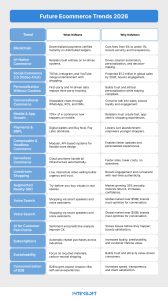
Among all e-commerce trends or tips making headlines, few are as transformative as this one.
Blockchain is a practical solution to a long-standing problem: the dependency on banks and middlemen for online payments. Instead of passing through layers of processors, payments are verified instantly through distributed ledger technology.
This setup reduces risks.
Each record lives on a decentralized network—a shared source of truth that doesn’t play favorites and doesn’t forget. Such an approach makes it nearly impossible to tamper with. The result: fewer security issues and more peace of mind for both businesses and customers.
What’s more, another reason that might get you thinking about blockchain—it lowers costs. Studies show remittance fees could drop from over 6% to less than 1% with blockchain-based payments. And instead of waiting days for an international transfer to clear, transactions are verified in minutes.
Of course, there’s still a “vanilla” version of e-commerce that sticks to the old systems—slow, costly, and opaque. But the businesses embracing blockchain in 2026 are writing a totally different story.
In 2026, one of the most defining current trends in ecommerce is artificial intelligence. It is no longer the sidekick, but running the show. The e-commerce world is dividing sharply: those who use AI and those who are built on it.
The first camp adds algorithms to accelerate what already exists. The second rewrites the playbook—where code is the bloodstream. They treat AI like a power tool — efficient, but not transformational. Then there are the AI-native players, born from AI itself. These companies don’t bolt intelligence onto existing workflows. They build entirely new machines. Their algorithms are decision-makers.
Even Elon Musk, with his ventures like Grok, is discovering just how steep the climb is to become truly AI-native. The difference between “adding” and “being” AI is widening fast — and the businesses that don’t adapt may soon find themselves lagging behind.
Here’s where IntexSoft lights the way. We stand firmly on the AI-enabled side. Our experts use automation and data analytics to make existing systems work smarter. But when clients are ready to take the next leap, IntexSoft can also engineer full-scale AI-native ecosystems. For example, e-commerce platforms that think and learn.
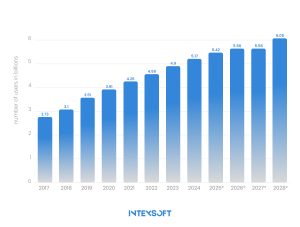
A new frontier is taking shape before our eyes: Social Commerce 2.0. E-commerce is entering its cinematic era. What began as quick clips and impulsive livestreams has become a full ecosystem. Entertainment, community, and checkout live side by side.
Video has become the new storefront. According to Statista, global social commerce sales are projected to hit $1.2 trillion in 2026, up nearly 35% from 2024. Platforms such as TikTok, YouTube, and Instagram have become commerce drivers. TikTok Shop’s transactions by themselves skyrocketed over 150% year-over-year via creators’ live product pitches and short-form videos.
The advanced Social Commerce 2.0 truly exceeds impulse-driven sales. Among the reasons are communal ties and AI-enhanced personalization. You can think of it as a shift from “See it. Click it. Buy it.” to “Experience it. Believe it. Own it.”
Look at Instagram Reels or YouTube Live Shopping. The lines between watching and buying have all but vanished. Users scroll, laugh, engage — and suddenly, they’re shopping. Even for small businesses, that’s gold: a fitness startup can host a live Q&A and, in real time. Its audience turns into customers.
Very broadly, the future of e-commerce is about connection. And in 2026, that connection starts with video.
For a couple of decades, third-party cookies have been the invisible glue of online advertising — tracking, targeting, and tailoring what we see on the web. But in 2026, that glue is melting away. Google’s long-anticipated cookie phase-out is here, and suddenly, one of the biggest digital commerce trends of the decade is about redefining personalization without those tiny trackers.
The end of third-party cookies isn’t the end of personalization. It’s the start of doing it wisely.
The question now is, can brands stay relevant — and profitable — when they can’t follow users around the internet anymore? The smartest ones aren’t waiting to find out. They’re shifting toward first-party data, AI-driven recommendations, and contextual advertising that aligns ads with the content being viewed, not the user’s private browsing history.
All the while, shoppers have grown tired of “the internet knowing too much.” The brands that adapt are building trust by being transparent — asking users to share data intentionally rather than taking it silently.
Giants including Nike and Sephora are exploring loyalty initiatives that compensate users for openly sharing tastes. This empowers algorithms to create personalized journeys ethically — a key marker of trends in online retail as brands look for privacy-first engagement models.
The next big thing is conversation.
The pattern links to what’s called messaging-powered commerce. WhatsApp, RCS, and other shoppable chats blur traditional lines. Browsing, chatting, and paying happen in one continuous exchange. The chat becomes the new storefront. The line between talking and buying disappears. No more friction. Just talk, tap, and buy.
The appeal is obvious. Instead of static email blasts or push notifications, conversational channels mimic human dialogue — answering questions, showing products, and closing the sale — all in one place. Subway saw a 140% boost in conversions using RCS instead of SMS. Sonic saw app downloads spike fivefold. Even smaller brands are finding that when conversations replace clicks, loyalty grows exponentially.
Behind every “Sure, I can help with that” message is an algorithm trained on thousands of customer journeys, constantly learning how to be better.
The smartest retailers are realizing that conversational commerce leads to digital empathy. Because when done right, shopping doesn’t feel like a transaction anymore. It feels like a relationship that talks back.
Nearly 70% of all e-commerce sales now happen on mobile devices, and that number keeps climbing.
The shift didn’t come overnight. The last X years have been a masterclass in adaptation — from clunky early mobile checkouts to sleek one-tap purchases powered by Apple Pay, Google Wallet, and biometric authentication. Today, ecommerce search trends show that most users don’t even start on desktop anymore. Their journey begins on social apps, in-app recommendations, or personalized push notifications that meet them where they already are.
This “mobile-first” world is being embraced by both old and new players. Traditional retailers are moving into the app game to get back on shoppers’ screens, while DTC brands have made buying feel like playing. The rules of mobile retail have shifted — if it’s not fast, fluid, and frictionless, it’s forgotten.
What happens when your customer doesn’t see the payment option they prefer? They leave. No second chance—just gone. Research shows 1 in 10 shoppers abandon their carts simply because the right payment method wasn’t there.
That’s why ecommerce leaders are reengineering their payment ecosystems around choice. Traditional credit and debit cards are now sharing the stage with digital wallets, mobile-first payments, and the increasingly dominant Buy Now, Pay Later (BNPL) models.
Digital wallets like Apple Pay and Google Pay have become the quiet heroes of mobile commerce—two taps, face scan, done. They’re fast, secure, and designed for shoppers who live on their phones. Tokenization, biometric verification, and one-click checkouts have made security nearly invisible, while convenience takes the spotlight.
Buy-now-pay-later platforms such as Klarna, Affirm, and Sezzle are changing the rules of checkout. They let users divide payments into clean, interest-free installments. This puts flexible spending within reach of nearly anyone. For Gen Z and millennials—who’ve grown wary of traditional credit—it’s financial empowerment wrapped in slick UX. For retailers, it’s pure conversion magic: lower cart abandonment, higher order values, and stronger loyalty.
Composable commerce is built like LEGO. Every block in such a system can move without collapsing the structure. Payments, search, personalization, analytics. All these become a modular piece connected through APIs. Obviously, this kind of nature of composable commerce gives ecommerce businesses more freedom, more wiggle room to innovate.
The second benefit that attracts online retailers today is control. Composable commerce lets brands escape the limits of all-in-one platforms. They can shape experiences that reflect their own identity, not a vendor’s template.
Headless commerce takes that flexibility even further. It separates the storefront from the backend—the brain from the face. So teams can design freely while the system logic runs untouched underneath. The payoff is agility and seamless experiences across every channel.
Industry players see it as scalable chaos that works. What does it mean? They can A/B test and launch regional storefronts. They can also inject AI-driven personalization. Businesses do not need to rewrite the engine. Frameworks like Next.js and Remix keep development fast. API-first setups ensure every piece of the puzzle connects cleanly.
At IntexSoft, we see a range of benefits in joining both. Together, composable and headless commerce form a living architecture—one that bends, adapts, and rebuilds without breaking stride.
Among the top ecommerce trends 2026, one shift is happening quietly but powerfully: serverless commerce. It’s not about shiny new apps—it’s about removing the heavy machinery that once slowed digital retail down.
Serverless changes the math of digital commerce. AWS and Google Cloud manage the servers, scale automatically, and keep systems stable through traffic spikes.
When demand surges, the system expands on its own. When traffic fades, it shrinks. That elasticity means brands pay only for what they use. The gain is speed and focus. Teams can build, refine, and personalize without worrying about hardware. Use this trend to get faster sites, lower costs, and cleaner operations. No idle machines and no wasted energy.
This isn’t just tech evolution; it’s mindset evolution. Serverless commerce turns infrastructure into an invisible asset—flexible, global, and automatic.
The once-static online catalog has been replaced by something kinetic, emotional, and alive. And it works.
The psychology behind live commerce is the same one that powered TV shopping in the ’80s — urgency, community, and social proof — only now, it’s personalized, mobile, and viral. Every second counts. The host’s charm, the countdown timer, the flashing “Only 3 left!” banner — they all trigger a familiar rush: act now, or miss out.
Livestreaming builds authenticity in a digital age that’s starving for it. When a brand answers questions live, with no edits or filters, trust is born in real time. Shoppers see the product, hear the pitch, watch the reaction — and believe.
For eCommerce players, the benefits are too strong to ignore. Live sessions slash cart abandonment, boost engagement, and create emotional bonds that banner ads never could.
In a landscape where consumers crave connection but drown in algorithms, livestream shopping feels refreshingly human.
The next phase? AI-powered hosts, 3D showrooms, and real-time translation that collapse global barriers.
AR is emerging as one of the clearest online shopping trends of 2026—a tool that reconnects the tactile world with the digital one. It brings back the missing sense of context—how something actually fits in your space. Aim your camera at an empty corner, and the armchair you’re eyeing appears, down to its texture and light. Open a beauty app, and the lipstick shade shows up on your own face — no guessing, no filters.
The market reflects the momentum. AR in eCommerce was valued at $5.8 billion in 2024 and is projected to hit $38.5 billion by 2030, expanding at a 35.8% annual clip. The reason? Experience sells.
Retailers are already all in. The fitting room has gone digital. Fashion retailers offer virtual try-ons that show how clothes flow as you move. Furniture sites let users drop 3D sofas into real spaces, testing size and color before checkout. Product pages, too, have evolved. 3D renders now rotate and zoom, revealing every stitch and curve. Online shopping online feels less like guessing, more like seeing.
Return rates drop. Conversion rates climb.
In 2026, shopping will go hands-free.
About 35% of Americans aged 12 and up now own a smart speaker, and they’re using it for a lot more than playing music. Voice queries are longer, more conversational, and more immediate. People don’t type keywords. They ask questions. That means retailers need to start talking back.
Brands that win in this new environment are the ones adapting their search and ad strategies to how humans actually speak. That means building for quick, natural answers, tightening up page speed, and injecting voice-friendly metadata that helps search engines surface the right results. Add in smart bidding and local intent — the “near me” crowd — and you’ve got a playbook for the next era of PPC and SEO.
The global market for voice commerce hit nearly $50 billion in 2024 and is projected to triple by 2030. That growth isn’t coming from tech enthusiasts — it’s coming from everyone else.
Retailers are using AI analysis to read the emotional tone of reviews. Machine learning models flag fraud before it happens. Predictive algorithms reorder stock before it runs out. AI-powered chatbots now resolve most basic support questions—fast—while handing complex cases to human agents who can actually help.
AI is redefining what a “pain point” is. Every return, complaint, or late-night support chat feeds AI systems designed to learn from the chaos. The loop never stops. It studies patterns, finds causes, and gets better with every cycle.
In the list of ecommerce marketing trends shaping 2026, AI stands out for one reason: it teaches companies how to think differently about them.

Remember when subscriptions were just for Netflix and Spotify? In 2026, they’ve gone fully mainstream—woven into the fabric of how we buy almost everything. From weekly coffee deliveries to monthly skincare refills, the model has become one of the most powerful ecommerce market trends.
For consumers, it’s about removing friction. The checkout happens once. Convenience takes over. Personalization has turned the humble subscription into something more intimate. Every box feels curated, every perk—a preview of belonging. Early access, members-only drops, quiet discounts. Traditional shopping rarely builds that kind of connection.
For ecommerce brands, this model brings order to chaos. Subscriptions turn fluctuating sales into reliable streams. Customer loyalty lasts longer, and average order values rise. Now, the sharpest players are blending subscriptions with loyalty programs—an ecosystem built on consistency and connection.
The buyers have truly transformed. They still love a good deal. But they also demand insight into how products are made, shipped, and disposed of. We don’t say this factor is always the deal-breaker when buying. However, for the new generation, shared values carry real weight.
Ecommerce brands are responding. Plastic is being replaced with recycled materials. Shipping is going carbon-neutral. Product pages are turning into transparency reports. And a fresh wave of online retailers is experimenting with circular models—resale, repair, and reuse. This makes sustainability a strategy that attracts more buyers.
Brands that can show their work—literally—win loyalty from the new generation.
2026 is the year the old B2B playbook dies. PDFs, endless cold phone calls, and manual purchase orders are giving way to a new reality. Buyers demand seamless, self-serve experiences that feel unmistakably modern.
Clients don’t want to “contact sales.” They want to log in, browse custom catalogs, see their negotiated pricing, and check out in minutes. No waiting. No friction. Just business, done efficiently.
Modern B2B platforms now combine role-based permissions, flexible payments, and personalized catalogs with an interface designed for effortless navigation. They truly bring Amazon-style ease to enterprise commerce. What does it mean?
Buyers can place bulk orders at midnight, track invoices, and reorder past purchases. No emails required.
The next level of B2B commerce is personalized intelligence. Companies are now able to match prices, products, and promotions to the particular demands of every individual account.
Now we can move on to the final part of the article. We have described each trend in detail, including the growing impact of ecommerce mobile trends shaping how customers shop and interact. But knowledge alone is not enough.
Each trend needs to be tested against the reality of your business. Does it fit the operation you’ve built? Can it sharpen your position in a crowded market? And is the price worth paying? The truth is, not every trend will serve you soon—or ever.
Now we offer a list of questions to help you approach these points critically:
Once you know which trends fit your goals and where challenges might pop up, the next step is getting your setup ready so those ideas can actually deliver results.
2026 has arrived, and the e-commerce world is on the verge of another shift. The field is moving faster, becoming smarter, and growing more competitive by the week. This article answers the question every e-commerce brand is asking: how to adapt?
Those that thrive will be the ones that read the undercurrent—the latest trends in the commerce industry shaping how people buy—and turn that insight into action. The harder question is this: how do you create more wiggle room to grow when time, budgets, and attention are tighter than ever?
Start small, but smart. Begin with all the doors artificial intelligence can open. This front-page tool may bring golden benefits—and has already taken the sales world by storm—in the foreseeable future. So, automate what you can. Every streamlined process gives you more wiggle room to innovate and lead.
The trends are already visible. But the truth, as always, remains uncertain. No one can fully script what comes next. What’s certain is this: partnering with the right experts to build and refine your e-commerce systems pays off in the long run. IntexSoft offers free consultations for C-level leaders ready to modernize and move ahead. If you’ve been waiting for the right moment to future-proof your online store—this is it.


The article explores AI's impact on ecommerce, highlighting its role in enhancing customer experiences and driving revenue.

This article highlights the top 10 eCommerce development companies to watch in 2026 across the U.S. and Europe.

This article highlights the significance of integrating the best marketing automation for ecommerce. It covers how ecommerce business owners can benefit from the right marketing automation solution.