

Read this article to uncover all the essentials of how to scale your product. How do you prepare an MVP for scaling? What are the key criteria to assess? Which situations lead to difficulties and challenges? And when should you avoid scaling your MVP? We’ll answer all these questions – and if you need personalized advice, we offer a free consultation.
Reading time: 18 min.
Some clients may think that an MVP – Minimum Viable Product – is a “lite” version of software‘s grand vision. But that’s not true. The very first thing to understand is that it’s a reality check: a stripped-down, no-frills prototype. And the primary goal of it is to answer one brutal question: Do customers truly need this idea – or not?

An MVP does one job, and it does it very well – it solves the problem your users actually have. No bonus features. No design awards. Look at the MVP as a signal to predict the future of your software.
Build an MVP, ship it, and brace yourself for impact. What comes back is real feedback – not market surveys or pitch-deck fantasies. Then, armed with that intel, you tweak, iterate, and evolve. Checked by this method, a functional sketch becomes something people might actually pay for.
This lean approach isn’t just about cutting costs (though it helps). It’s about cutting the crap. You don’t need a million-dollar launch to validate an app idea – you need a browser, a backend, and a sense of focus. MVPs let software projects move fast and avoid going broke while doing it.
The MVP is your rough draft with a purpose: get it out fast, test the waters, and see if the idea even floats. The full-scale product? That’s the polished, all-in version built for the big leagues – feature-complete, market-ready, and engineered to scale. One is a probe. The other is a launch.
Now, let’s decode the difference in the table below.
| Feature | MVP | Full-Scale Product |
| Purpose | Validate the core idea. Is it even worth building? | Deliver a complete, market-ready solution. |
| Development Speed | Fast and focused – think sprint, not marathon. | Slow burn – meticulous, thorough, fully fleshed out. |
| Functionality | Only the essentials. No fluff. No extras. | Loaded with features, integrations, and polish. |
| User Base | Early adopters, testers, feedback-givers. | Broad audience, from casual users to enterprise clients. |
| Design | Barebones UI/UX. Enough to work, not to wow. | Refined visuals, seamless experience. Built to impress. |
| Risk Level | Low investment, high learning curve. | High stakes, high reward – or high fallout. |
| Scalability of a Product | Not the point – yet. | Architected for scale, performance, and longevity. |
| Budget | Lean, scrappy, cost-efficient. | Budget needs a serious line item. |
| When to Use | You’re testing uncharted waters. | You’ve got proof, funding, and green lights all the way. |
We’ve weighed MVPs against full-blown product builds — and MVPs are usually the smarter play. They’re lean, fast, and designed to fail early or fly. But let’s not get dogmatic. There are moments when going all-in from day one actually makes common sense.
There’s this myth in startup land that once you ship an MVP, you’re halfway to the moon. Reality check: most MVPs don’t scale, and a lot of them aren’t supposed to. They’re brittle by design.
And there are five situations when we recommend avoiding scaling your MVP. Let’s break all of them down.
MVPs are like prototype spacecraft. They’re built fast, often duct-taped together, and intended to crash safely if they must. Nobody’s running performance benchmarks on that early-stage backend — it just has to work once. Maybe. But if your infrastructure chokes when traffic triples or your database schema wasn’t built to scale horizontally, you’re not “scaling” – you’re detonating. Without scalable product architecture, you’re asking a paper plane to survive reentry. Don’t pretend a skateboard is a Tesla.
Many MVPs are coded fast, not smart. Infrastructure held together with duct tape – inefficient databases, backend frameworks that buckle under pressure. When users increase, the whole thing can crack. If you have faced this situation, you should avoid scaling chaos and concentrate efforts on fixing it. That fix must prioritize production scalability, not just a prettier interface. And it needs to happen before the surge, not after it begins.
Tech moves fast. Faster than most founders can pivot. While you’re refining your onboarding flow, a competitor with better timing just built a native integration for the thing your users want. Consumer expectations are liquid. What was innovative six months ago is table stakes now. Market awareness is the air your product breathes. MVP scaled agile frameworks can help react to this kind of turbulence–but only if you’re not stuck rewriting foundational code.
You probably didn’t architect your MVP with GDPR, HIPAA, or whatever acronym will wreck your dev cycle next quarter. That’s fine–until it’s not. Once you start scaling, regulatory gaps become legal liabilities. Remember, retroactive compliance is a money pit. Build with privacy and governance in mind from the start.
Let’s talk economics. If your customer acquisition cost is higher than a streaming platform’s churn rate, or your LTV math depends on fantasy retention curves, scaling is just setting fire to your own runway. Investors might tolerate that–briefly–but unit economics always win in the end. You can’t optimize negative margins into a viable business. You can only delay collapse.

Now comes the real game: scalable product meaning is closely connected with a pressure test of everything you’ve built so far –architecture, process, vision. You’ll need to shift from scrappy experiments to stable systems without losing the soul of what made your product useful in the first place.
Here’s how to scale without turning your product into a slow-moving, feature-bloated.
Before you ship anything at scale, talk to your users. Not in a “please rate us five stars” kind of way – but like a human. What do they actually use? What do they avoid? What weird workarounds are they inventing that point to a missing feature or clunky UX?
Stop looking for validation and start looking for pain points. Read every support ticket. Lurk in your community Slack or Reddit threads. The data’s there – you just need to admit what it’s telling you.
Now that you understand true feedback, resist the urge to build everything. Your MVP roadmap isn’t a democracy. It’s triage. Scaling means prioritizing what creates real value – and shelving the rest, even if it’s shiny.
Does this feature reduce friction? Does it deepen engagement? Or is it just nice-to-have noise?
Every new feature adds complexity. Every new flow adds surface area for bugs. Keep your product tight, not bloated.
MVPs are fragile by design. But if you’re scaling, that prototype backend with its single-node database and hand-rolled API calls won’t cut it. You need to think in terms of resilience, elasticity, and load balancing.
That means:
In MVP mode, development is chaotic on purpose. Speed > structure. That is why you will need some rules, but keep them lightweight:
And most importantly: kill the hero culture. You don’t need one superstar dev pulling all-nighters – you need a reliable team that writes boring, predictable code that works.
So now your product is stable. Users are coming in. You’ve got real infrastructure and a dev process that doesn’t melt under pressure. Good. Now forget the word “done.”
As scaling isn’t a one-time event, start continuous monitoring and iteration. You need to:
Speed matters, but clarity matters more.
Move fast – but not headfirst. Simplify – but don’t dumb it down. The art is in that uneasy middle ground: knowing when to go, and knowing what not to strip away. This isn’t about rushing – it’s about being ready to act when hesitation becomes a risk.
This is where sustainable growth lives: not in hype, not in blind velocity, but in the tension between urgency and intention.
Now take that mindset and apply it with precision. Because readiness to scale isn’t just about infrastructure or user numbers. It’s about alignment – across product, people, process, and purpose.
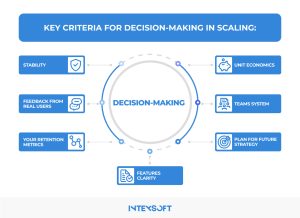
Here’s what else you need to assess:
Start here: can your product handle the load? Or is it already limping on every login?
A real sign of scale readiness isn’t growth – it’s stability under stress. If your app idea throws 500 errors when user #401 signs in, you’re not scaling, you’re detonating.
Run load tests. Break it on purpose. Watch what fails first. If your backend buckles during a demo, you’re not ready.
The early adopters tolerate bugs, tweet feedback, and forgive your terrible UI because they loved the idea.
But if you’re going to scale, you need signals from the next tier: real users with real problems. Are people outside your startup bubble sticking around? Are they using the product without needing a walkthrough or a founder on call?
If your growth is still built on goodwill, it’s not a product-market fit.
This is where most MVPs flunk the test: people come, click, and bounce.
If people aren’t coming back, don’t scale.
Are you scaling the backend? The team? The feature set? The marketing budget?
If the answer is “all of the above,” slow down. You don’t scale everything at once. You scale what’s working.
If your referral loop is tight, scale that.
If your onboarding is converting, scale that.
But if your core product still feels like an experiment? Scaling won’t save it – it’ll bury it in tech debt and user complaints.
Are you building a product – or a charity?
If your customer acquisition cost (CAC) is higher than your lifetime value (LTV), scaling is just accelerating bankruptcy.
And if your margins are vapor-thin or nonexistent, adding more users won’t help.
Before scaling, fix your pricing model. Simplify your funnel. Cut costs where you can. Growth without economic logic is just a longer runway to crash.
In MVP mode, it’s normal for founders to do everything – from shipping code to answering support tickets at 3 a.m.
But scaling means building a system that works without you.
That means:
If your startup still runs on heroics and Slack messages at midnight, you’re not ready.
Last test: do you know what the next six months look like – technically, operationally, and strategically?
What are you measuring? Who owns what? What breaks when you triple your user base?
If you can’t answer those questions now, scaling won’t magically solve them. It’ll just expose them in public.
| Problem | What Breaks | Why It Matters | How to Prevent It |
| Technical Infrastructure | Systems lag or crash under user load | MVPs aren’t built to handle real-world usage at scale | Architect with modularity and load in mind – even if it feels premature |
| Scalability of Database | Queries slow down, data retrieval fails, risk of data loss | MVPs often use duct-tape database setups just to get to launch | Use relational models, indexing, and consider horizontal scaling from the start |
| User Experience | UI breaks under complex use cases; UX feels inconsistent across touchpoints | MVPs deprioritize UX – until users start leaving because it’s not intuitive | Start UX audits early; assume every new user won’t give you the benefit of doubt |
| Team Scalability | Burnout, miscommunication, feature delays | A small MVP team can’t sustain a full product rollout | Structure for scale: roles, workflows, and cross-functional clarity |
| Integration & Interoperability | External tools fail, APIs break, partner systems clash | MVPs often skip real integration testing – just plug it in and hope | Design APIs with the assumption that they’ll be used beyond your control |
There’s no single blueprint for scaling. But if you want your product to survive past MVP status, don’t wing it. There are patterns that work – and shortcuts that backfire hard.
And if you’re wondering when to move – or how to build something that won’t crack under pressure – IntexSoft has been there. Scaling MVPs into real, market-ready platforms is what we do.


This article dives into the core differences between MVPs and MMPs, breaking down when to use each, along with real-world examples—both good and bad.

Let’s discover how building a Minimum Viable Product (MVP) can help your startup achieve product-market fit.

We’ve explored the MVP landscape from multiple angles.