The Future of Customer Engagement: Real-Time Scoring with Python
Business
Business Process Automation
Design & Marketing
E-commerce development


With real-time lead scoring, businesses identify buying intent as it happens and prioritize high-potential opportunities faster. Static scoring models rely on fixed rules that quickly become outdated, causing sales teams to miss valuable signals. In this article, IntexSoft explains how AI, ML, Python, and specialized libraries improve lead qualification, explores the five key stages of implementation, and shows how businesses can build conversion-focused lead scoring systems.
Reading time: 17 min.
For years, lead scoring followed a familiar manual process: checking job titles, company size, website visits, email clicks, and maybe a downloaded piece of content. Sales or marketing teams built structured frameworks to rank opportunities and assign lead value. The process created consistency. It introduced structure. But it still relied on static assumptions rather than real-time buying intent.
The limitations became difficult to ignore. Scoring models varied across teams, signals were interpreted differently, and prioritization often lacked accuracy. The very system designed to improve visibility frequently slowed decision-making instead of strengthening it.
Lead scoring predictive analytics changed the model. By replacing assumptions with behavioral signals and data-driven insights, businesses gained the ability to identify intent as it forms and respond faster. Lead prioritization became more accurate. Sales cycles moved quicker. Decision-making improved.
Business leaders recognized the shift early. Companies invested in AI lead scoring technologies to improve conversion visibility and reduce wasted sales effort.
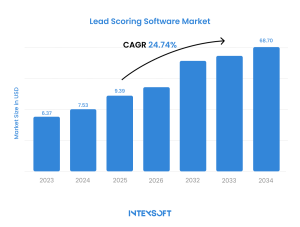
Market forecasts through 2034 show continued growth:
Real-time lead scoring is an AI-supported system that helps businesses prioritize leads dynamically.
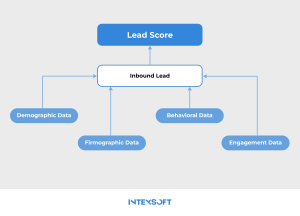
Lead scoring helps businesses evaluate how likely a prospect is to become a customer. When implemented effectively, it allows organizations to prioritize opportunities and focus sales efforts on leads with the highest conversion potential.
That is where marketing automation lead scoring becomes very important. Instead of manually assigning values in spreadsheets, algorithms handle the process automatically.
A lead scoring algorithm interprets both static attributes and behavioral signals, including clicks, time spent, repeat visits, and activity patterns that indicate true buying intent.
On paper, it seems simple. In practice, thousands of leads and variables quickly make the process more complex.
The process begins with tracking behavioral signals: ad clicks, website visits, email engagement, and activity across LinkedIn or X (Twitter). The data then flows into the lead scoring system.
Platforms like HubSpot have operationalized this approach. They integrate data from multiple sources and produce what executives call a “comprehensive view” of each prospect. Behind the scenes, machine learning identifies patterns that are often invisible to the human eye.
The mechanics are both technical and practical. Demographic markers – company size, industry, job title. Behavioral signals – page views, downloads, event signups. Firmographic data – revenue, location, employee count. All of it enters the model.
Zoho, Salesforce, and other AI-based CRMs parse inputs, run comparisons, and detect trends, allowing systems to move beyond simply describing what happened. It enables true predictive lead scoring.
The structure rests on four key components:
The toolset is extensive, and platforms such as Google Analytics and Adobe Analytics provide the raw data that powers the models. But algorithms alone are not enough. The most effective lead scoring combines AI with human judgment. Machines calculate. People contextualize. Together, they improve precision.
AI lead scoring tools are becoming the filter, the sorting mechanism.
AI-driven, real-time lead scoring doesn’t happen in a vacuum. It unfolds in phases. Each phase is equally important:
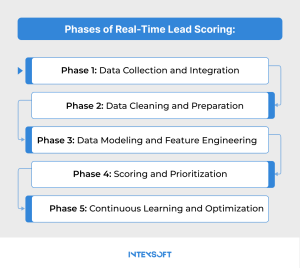
Real-time lead scoring starts with infrastructure. In most projects, feature engineering takes a major share of development effort, as raw signals must be converted into predictive features in real time.
A modern lead scoring platform does more than collect CRM logs or website clicks. It brings together signals from email campaigns, automation flows, social channels, and behavioral activity. Demographics and firmographics are added to the mix. The goal is to turn changing customer behavior into scoring inputs.
But how reliable can predictions be when data remains fragmented or siloed?
The key priority of this phase is eliminating training-serving skew. Feature logic must remain identical across both historical and live data. A feature store creates a single source of truth.
Due to duplicates, errors, and incomplete fields, raw data is rarely clean, and unresolved issues can distort the entire lead scoring process. This is where AI creates additional value – something IntexSoft has been applying for years. Your business can move beyond simply cleaning data and begin transforming it.
Client experience shows the cost of ignoring data quality early on. When ML systems are trained on “dirty” data without regular updates, drift reduces accuracy by 18–32%. That is not a marginal decline. At that point, the model behaves less like a high-performing lead scoring system and more like a random number generator.
At this stage, history becomes the model’s teacher. Past wins and losses shape the training dataset. Machine learning then identifies hidden patterns: who converted, who did not, and which actions made the biggest difference.
The algorithm weighs hundreds of variables, adjusts priorities, and, most importantly, rigorously tests business assumptions against real data.
For example, repeated visits to a pricing page often turn out to be a stronger buying signal than a senior job title. The data supports this.
ML models reveal patterns that are easy to miss manually. Prospects who take high-intent actions early in the journey, such as downloading technical specifications, are often far more likely to convert. Without a lead scoring platform, sales teams rarely spot signals like these before the opportunity is gone.
Then comes the application. Scores are assigned, often on a 100-point scale. The higher the score, the more closely a lead resembles past customers.
The model separates the noise from the signal:
Sales teams no longer need to debate where to focus. Prioritization happens automatically. The question shifts from Who should we contact? to How quickly can we act?
The final stage never stands still. Every new lead and conversion feeds fresh signals back into the system. As behavior patterns change, models recalibrate and scoring accuracy improves over time.
In marketing automation lead scoring, leads are scored continuously, not once. A prospect who initially engages with a blog post but later joins a product demo moves higher in priority. Can real-time systems detect these changes? Yes. Manual processes, as a rule, miss them.
Thanks to this “intelligent” approach, organizations can achieve higher conversion rates than with classic methods. According to the Predictive Lead Scoring report, companies replacing static rules, such as “company size > 100 employees,” with real-time ML models report an average 75% increase in conversion.
Let’s get the main bullet points on the difference between the two down in the table below:
| Factor | Traditional Lead Scoring | Real-Time Lead Scoring |
| Basis of Scoring | Manual rules, predefined by sales/marketing teams | Data-driven, dynamic, and adaptive models (often AI-powered) |
| Flexibility | While buyers evolve in real time, the system clings to old rules | Learns and updates instantly as new data comes in |
| Accuracy | Prone to human bias, inconsistent across teams | Objective, consistent, and continuously optimized |
| Data Sources | Limited to firmographics, job title, or basic engagement | Combines firmographics, behavioral signals, and live digital interactions |
| Speed | Lagging – insights only as good as the last rule update | Immediate – scores update in real time as actions occur |
| Scalability | Difficult to scale, time-consuming to maintain | Scales effortlessly with CRM and integrated systems |
| Impact on Sales | Sales reps may chase low-value or outdated leads | High-value leads are surfaced instantly for faster action |
| Trust & Alignment | Relies on intuition and subjective weighting | Builds trust with objective data and unifies marketing & sales |
| Business Risk | Inefficiency, wasted effort, missed opportunities | Increased efficiency, higher conversions, competitive advantage |
Now, we can explore the ideas in more detail.
As shown in the table, traditional lead scoring depends heavily on human judgment. One sales rep may rank a director at a mid-sized company as a high-value opportunity. Another may not. Even when digital adoption platforms supply user data, scoring often remains static and based on fixed rules.
Traditional scoring can still create structure – a common language between marketing and sales. But structure alone is no longer enough. Markets shift quickly. Buyer behavior shifts faster. Static scoring frameworks struggle to keep pace with signals that change by the day, sometimes by the hour.
Millennial decision-makers increasingly expect speed, relevance, and personalized interactions. Traditional scoring models rarely adapt. The result: qualified leads are missed, sales effort is wasted, and opportunities are lost.
That is why InsightmarkResearch’s March 2026 analysis matters. Sales teams using AI are 1.3x more likely to report revenue growth through improved lead prioritization. The impact is measurable. Sales teams spend less time on low-intent leads. Real-time scoring helps reduce subjectivity, inconsistency, and manual error. Marketing teams align campaigns around higher-potential prospects, while sales teams focus on leads that are more likely to convert. Efficiency improves. Conversion rates follow.
Your business can realize five key benefits early in implementation:
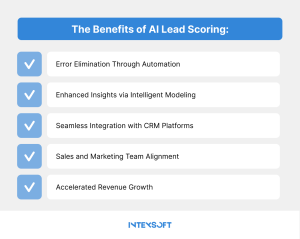
IntexSoft recommends that companies start with clearly defined goals, from reducing the sales cycle to achieving measurable outcomes, such as increasing conversion rates by a specific percentage. Depending on the objective, system architecture may vary significantly.
A second important point is consistency across teams. The same strategy should be followed across all departments involved, usually sales, marketing, and analytics. Under these conditions, forecast accuracy of 90-95% becomes realistic.
There is also a less visible challenge tied to B2B data privacy. Client names, behavioral data, and transaction history are central to how the system operates. Trust in both AI and your business will depend largely on how this data is processed and protected. That is why, at IntexSoft, we assign a dedicated specialist to ensure strict governance through implementation and provide explainability for every score. In B2B data environments, this is often a regulatory requirement under frameworks such as General Data Protection Regulation (GDPR).
Now that you have a clear set of priorities, a shared strategy, and data protection in place, start small. In practice, we have found that this approach delivers better results than trying to implement everything at once. Apply lead scoring machine learning to a limited lead segment and compare the results immediately.
Consider the hidden costs of moving too fast. Companies often end up rebuilding workflows, retraining models, or fixing adoption issues that could have been avoided earlier.
We take care of AI lead scoring model training, while your role is to prepare employees in advance. Without this alignment, even leading ML scoring tools often fail to deliver results because sales teams may be unwilling to trust the algorithms. IntexSoft’s implementation experience points to one recommendation that consistently delivers results: introduce “scoring buddy systems.” These peer-based support systems can improve technology adoption by up to 85%. We explain how to apply this approach in practice and where it fits within broader AI development services during the first free consultation.

The implementation of the best AI model matters just as much. During consultations, IntexSoft technical experts often recommend a hybrid approach that combines automated lead scoring with human validation, as the right setup depends on your business context. At the same time, hybrid B2B scoring consistently delivers an average ROI of 300–400% within the first year.
Python is an appropriate programming language in this way, as this instrument is truly lean, open, and built for speed.
The mission is unmistakable: take streams of data (CRM records, campaign responses, web clicks, even social chatter) and turn them into scores that mean something. Scores that executives could read in minutes, not days. At the center of this effort is a lead scoring platform. Python software development makes it practical.
The path looks like this:
Python-native frameworks change the economics of real-time system development. Compared to traditional Java-based platforms, businesses can build streaming systems up to 8x faster while using up to 25x less memory.
The first thing any backend developer will tell you: real-time lead scoring in Python requires moving beyond traditional batch processing. The shift is toward online continual learning, where models adapt to customer behavior as it happens. The results? Faster lead prioritization and system response times within 100 milliseconds. This aligns with the Doherty Threshold principle.

What technical aspects should your business consider for an AI lead scoring system?
Forget traditional libraries such as scikit-learn. They are designed for static datasets. This makes them less suitable for streaming data and predictive lead scoring environments.
That is why IntexSoft commonly works with the following technologies:
If your priority is to create a reliable streaming ML pipeline, this Python framework is a truly strong option. It uses dictionary-based structures to enable fast feature access (O(1)) and allows models to adapt as new data points appear in the stream.
Designed as a library that combines Python’s flexibility with the performance of the Java-based MOA framework, CapyMOA improves the way teams evolve data streams. This becomes especially relevant when data volumes grow faster than pure Python can keep pace with.
A Rust-based streaming engine designed to build scalable data pipelines in Python. It helps accelerate development and can reduce implementation time by up to 8x compared to Java-based alternatives.
A framework that connects River’s online learning algorithms with PyTorch neural network architectures. This enables more advanced real-time modeling and continuous adaptation.
Feature engineering can account for up to 80% of development effort.
In lead scoring machine learning, the following elements matter most:
Sliding windows help track recent behavioral trends, while session windows provide visibility into user activity during a single visit.
These platforms solve the training-serving skew problem, inconsistencies between training and production data. They provide a unified way to calculate features across historical datasets and live data streams.
Enables sub-millisecond access to user context in real time. This includes signals such as the number of items added to a cart within the last five minutes, helping models respond to behavior as it changes.
To improve real-time lead scoring accuracy, often reaching 95–97%, IntexSoft relies on three approaches:
Frequently applied in lead scoring B2B to improve accuracy across behavioral and firmographic data.
Built for streaming environments, these decision trees update incrementally with every new data point, reducing the need for full model retraining.
Combines multiple decision trees to detect behavioral changes and adjust scoring accuracy over time.
Every lead scoring algorithm from the list above performs best when paired with continuous adaptation.
Why does this matter? Customer behavior and engagement patterns change continuously in real time. That is why technical implementation should include:
A mechanism that dynamically changes the size of the data window. If model performance drops, the window becomes smaller and improves adaptation speed.
The Population Stability Index and similar methods help monitor drift between historical and real-time data.
Outcomes such as whether a customer converts often become visible days or even weeks later. In lead scoring machine learning, we use a special strategy, Experience-Delayed Replay. As a result, instances are prioritized for model retraining. Labels with shorter delays and higher classification errors receive greater weight. Once seasonal campaigns end, static scoring models often keep treating low-intent traffic as high-priority for several weeks. Faster retraining helps restore accuracy sooner.
Rather than using traditional train/test splits, real-time systems rely on a test-then-train cycle (prequential evaluation).
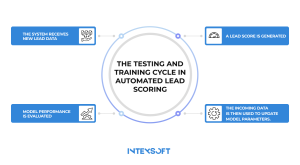
As shown in the scheme, the test-then-train cycle ensures that models are always evaluated on data they have not yet seen during training. That is exactly why businesses can rely on more accurate and adaptive predictive lead scoring with Python.
At IntexSoft, we see lead scoring as a business advantage with measurable impact. Companies do not invest for years to see distant returns. Most of the investment happens upfront during Python development, AI and ML implementation, after which the system moves into an ongoing support model. Even a basic support level is often enough to keep costs predictable, with updates included. The payoff comes early. Faster conversion growth and measurable first-year results are where lead scoring proves its value.


In this article, we explore the patterns behind ecommerce vulnerabilities and how AI is redefining both risk and protection.

The article explores AI's impact on ecommerce, highlighting its role in enhancing customer experiences and driving revenue.

Let’s learn how to harness the power of AI-powered analytics to gain valuable insights and make data-driven decisions. This article discovers the latest tools and techniques for leveraging artificial intelligence in your analytics strategy.