How Python Powers Legacy System Modernization: Techniques and Success Stories
Business
Business Process Automation
Painless development


Is legacy software slowing you down? Python could be your golden ticket. It’s fast, flexible, and plays well with modern systems. But performance hiccups and messy integrations can still cause trouble. Explore our article on upgrading the smart way—learn from real-world success stories, proven techniques, and expert strategies. Plus, get a free consultation from our team.
Reading time: 19 min.
Legacy systems are old and toxic. They kill your speed, block your tools, and burn through budgets while innovation waits on the sidelines. If your developers can’t ship fast or integrate new APIs without pain, your stack is not modern.
Look for these five indicators. They could be costing you more than you think:
See those red flags? That’s your cue—it’s time to act. Legacy systems don’t fix themselves. Modernizing starts with smart choices, and going all-in on Python is one of the smartest moves you can make.
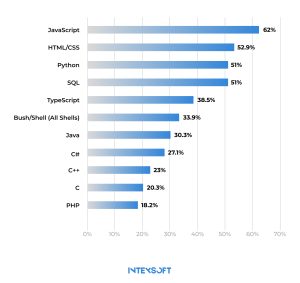
Here’s how Python directly tackles the five biggest pain points IntexSoft has already covered:
To understand what drives success—and what doesn’t—one must look closely at those who have tried, adapted, and evolved. Let’s uncover Shopify and Walmart cases.
Modernization doesn’t always mean microservices. Shopify didn’t ditch its monolith. It rebuilt it—modular, deliberate, futureproof.
The company’s early infrastructure was a classic all-in-one monolith. Elegant in the beginning. A nightmare at scale. As the platform expanded, the monolith morphed into a bottleneck. Velocity dropped. Integrations became brittle. Innovation started moving at a speed.
So Shopify engineers didn’t bulldoze the whole thing. Instead, they rewired it—component by component—into what they call a modular monolith. Think: one codebase, many minds. It was a brilliant example of architectural discipline.
Engineers at Shopify took three key steps:
Testing tightened. Deployments got boring (in the best way). Developer productivity surged—not from magic, but from reduced mental overhead.
It started with a problem that plagues legacy enterprises everywhere: scale without flexibility. Walmart’s infrastructure was built for consistency—not for a world of flash sales, app-based loyalty programs, and AI-driven inventory. Every new feature, every spike in traffic, came with friction.
So Walmart did what few companies its size dared to do. It went to a full architect.
The answer? A sprawling hybrid cloud architecture is known internally as the Triplet Model. The model knits together public cloud providers, three massive private data hubs (West, Central, East), and a fleet of more than 10,000 edge cloud nodes embedded closer to stores and customers.
Here’s how Walmart engineered its cloud future:
Let’s look at how developers are using Python to reengineer the old and future-proof the core. There are 5 approaches to assess:
| Approach | Description | Python Role | Tools/Tech |
| Refactoring | Clean, modular rewrites of legacy code | Improve readability & testability | pytest, black, mypy, ruff |
| Replatforming | Moving existing logic to modern infrastructure | Wraps legacy systems in modern environments | Flask, FastAPI, Docker, Kubernetes |
| Re-architecting | Shifting from monoliths to microservices | Builds scalable, async services | Django REST, FastAPI, Celery, Airflow |
| Interfacing/Extension | Connecting legacy with modern systems via bindings and scripts | Acts as glue code | Python.NET, Jython, ctypes, Cython |
| API Wrapping | Exposes legacy features via RESTful APIs | Adds external interfaces | Flask, FastAPI, Swagger |
This approach is a wise one for any minimalist. Developers methodically replace tangled legacy logic with modular Python scripts.
Monolithic procedures are broken into testable, readable functions. With Python’s rich standard library and specific tools, development teams can steadily rewrite legacy modules—especially those written in legacy Python—without pausing operations.
Replatforming means migrating your existing functionality onto modern infrastructure without touching core logic. Python shines here, acting as a translation layer between legacy APIs and cloud-native services.
For example, Python frameworks like FastAPI and Flask can wrap legacy logic into lightweight APIs. Add a container strategy via Docker, and your old payroll module now talks fluently to Kubernetes.
Python is increasingly central in decomposing monoliths into microservices.
Frameworks like Django REST and FastAPI allow teams to spin up independent services for billing, authentication, or inventory. With async support and orchestration tools like Celery and Apache Airflow, Python services can scale horizontally, communicate via lightweight protocols (gRPC, REST), and fit cleanly into distributed ecosystems.

The core of this approach is based on the fact that legacy systems aren’t always expendable. Sometimes, they just need a modern partner. Python’s strength lies in interoperability—embedding with C/C++, calling Java via Jython, and bridging into .NET with Python.NET.
This makes Python ideal for writing glue code—extensions, automation scripts, and data processing bridges that interface with ERP systems, SAP instances, or proprietary databases. It’s how modern AI/ML pipelines get hooked into 90s-era CRM platforms.

Python excels at API-first modernization. If your legacy app can’t be rewritten or replaced, Python can wrap it—exposing key functions through RESTful APIs using Flask or FastAPI.
Now, your 20-year-old accounting system can sync with your Shopify store or push updates to Salesforce. This approach buys time, builds agility, and reduces business disruption.

How is Python being deployed to bring yesterday’s infrastructure into tomorrow’s cloud? Let’s highlight several legacy modernization techniques:
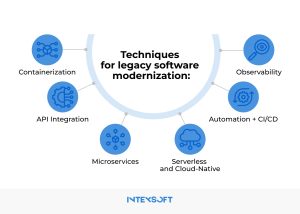
Tools like Docker and Kubernetes encapsulate Python apps with all their dependencies, freeing them from outdated servers and making them portable across development, testing, and production. You’re no longer babysitting runtime quirks—you’re deploying anywhere with confidence.
Big tech and startups are containerizing backend services originally built on bloated frameworks. With Python’s minimalist footprint, wrapping legacy logic into fast, containerized micro-apps is practical.
As we mentioned it above, with frameworks developers are turning monolithic functions into clean, RESTful endpoints. These APIs expose data and wrap complex business logic in modern interfaces. As a result, legacy systems that speak fluent mobile, web, and cloud.
Python is especially important in this space because it makes integration fast, readable, and scalable. You can wrap a 20-year-old COBOL system behind a sleek API layer in weeks.
Python is ideal for spinning up these lightweight services. With frameworks like Django, FastAPI, and Celery, teams are breaking down legacy systems into discrete, scalable services that can be developed, deployed, and maintained independently. Add RabbitMQ or Kafka to handle asynchronous communication, and you’ve got a system that breathes—flexible and designed to evolve.
Python’s seamless compatibility with AWS Lambda, Google Cloud Functions, and Azure Functions makes it a top contender for running business-critical logic in the cloud, without maintaining infrastructure.
Legacy systems usually don’t scale gracefully. But wrapping functions in Python and deploying them serverlessly gives you instant elasticity. Your code runs when it needs to. No servers to patch. No idle costs.
Legacy systems hate change. Python makes it predictable.
CI/CD pipelines built with GitHub Actions, GitLab, or Jenkins, powered by Python scripts, bring continuous testing and deployment to systems that once required manual ops intervention.
Modernizing a black box is a bad idea. Python integrates with tools like Prometheus, Grafana, and Elastic Stack, letting teams monitor performance, trace transactions, and detect failures in near real-time.

Before you jump into the code, there are three hard truths every team needs to face: costs, complexity, and business goals. Let’s break it down.
We’re talking microservices, containers, cloud-native architectures, UX overhauls, and full-on codebase rewrites—executed by IntexSoft engineers who blend deep tech fluency with real-world pragmatism.
Still skeptical? Dive into our portfolio to explore more modernization examples.
Here’s what’s on the slab:
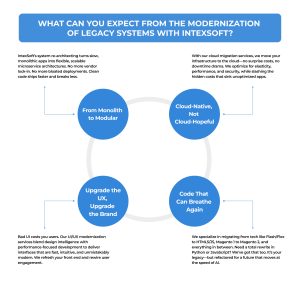
Why IntexSoft? Because before a single line of code changes, we:
You’re not alone—half our clients were here too. From a multimedia automation suite to eCommerce engines serving thousands daily, we’ve already helped dozens of clients ditch legacy drag. Some highlights:
Modernization starts with knowing what’s broken. That’s why we offer free audits for:
Ready to break free? Modernization doesn’t have to be chaotic or costly. With IntexSoft, you get a partner who’s already solved it—system by system, stack by stack.
Let’s future-proof your software and unlock the growth your business deserves. Start with a free audit.
Legacy modernization used to be a slog—slow, risky, and thankless. But Python, with its agility and deep ecosystem, flips the script. It doesn’t replace legacy systems with shiny tech for the sake of it. It gives engineers the tools to refactor what works, replace what doesn’t, and future-proof what matters.
We can say in advance what modernization in 2025 does not require demolition. It does not require stopping the business or rewriting everything. It requires precision. Rewrite just enough. And do it in a language the business understands. In Python.

Python and Java have been struggling for a leading position among the most popular programming languages for quite a while. Python has recently caught a lot of popularity.

Why is Python a great tool to achieve excellent business process automation? Read about it in this article.

This article focuses on IT automation with Python. You will learn why this programming language performs exceptionally well in automation tasks.