

In this article, you’ll learn about the curveballs many companies face when they grew too quickly in development. We uncover the key factors behind this rapid growth — and the red flags that signal the need for immediate action. Read on to explore all the risks in detail, along with several well-known examples. Need more information or a free consultation? Contact us.
Reading time: 17 min.
Speed, in the tech world, has always been the thing that many businesses see as a prime benefit. Launch fast. Scale faster. Ship before anyone asks if it’s ready. But behind every record-breaking sprint lies a ledger most teams never open until it’s too late. Technical debt, sleepless nights, outages that hit during peak traffic — these aren’t flukes. They’re the byproduct of rushing for the sake of movement.
Natural growth doesn’t look like chaos. It’s deliberate. It reflects a cadence — a rhythm — where each feature, each release, builds on something solid beneath it. Smart development isn’t about resisting speed. It’s about understanding that speed without structure is fragility in disguise.
The most seasoned engineering leads know this: progress that lasts comes from systems that are designed to evolve. Growth that is truly sustainable comes with guardrails — testing frameworks, build automation, observability, and processes that protect teams from themselves.
Because when you chase velocity without vision, the cost doesn’t show up in the next sprint. It shows up in the next crisis.
To keep your teams high-performing and achieve better business results, leaders need to understand the hidden costs of moving too fast and start implementing solutions with common sense. This article by IntexSoft has you covered.

In tech, the market punishes those who slow down. Let’s understand the core three reasons why businesses prioritize fastness in web development.
In today’s hyper-competitive digital reality, releasing quickly is necessary and even existential. Companies that prioritize speed in software delivery grow their revenue faster than those that don’t. Amazon deploys code every 11.7 seconds. Netflix runs thousands of deployments daily.
Speed gives you a first-mover advantage. It means being the first to capture user attention, to iterate on feedback, and to lock in market share before the competition even wakes up. Fast development cycles compress the distance between an idea and a product, and in a crowded market, that distance can make a difference.
Speed reduces cost. That’s the part most execs miss. Agile development, CI/CD pipelines, and build automation don’t just get features out the door — they minimize the hours burned in manual handoffs, status meetings, and endless QA bottlenecks.
Elite DevOps performers — teams who deploy quickly and often — spend 50% less time fixing security issues and experience fewer failed deployments. Why? Because rapid iteration improves code quality over time. Bugs surface faster. Fixes deploy quicker. Feedback loops tighten.
The longer you wait to ship, the more your backlog bloats. In a lean dev shop, slow is expensive.
Consumer expectations have caught up. A study from PwC shows that 43% of users expect new features regularly, with nearly 60% abandoning apps that feel stagnant. Users want evolution. Now. Today.
This obsession with speed is baked into how we measure success. Time to market. Sprint velocity. Weekly active users. The faster you iterate, the faster you learn. And the faster you learn, the better you build.
But here’s the twist: while speed is seductive, it can also be dangerous. In the rush to ship, many companies overlook the hidden costs — technical debt, burnout, and brittle systems held together by duct tape and hope.
The next section explores why slowing down might just save your roadmap.

Let’s look at the indicators you shouldn’t ignore or turn a blind eye to. These signs reveal that your business may be growing too quickly. We’ll also explore what each one means and why it truly matters.
| Red Flag | What It Means | Why It Matters |
| Cash Flow Is Insufficient | Revenue looks strong on paper, but expenses and operational costs outpace incoming funds. | You can’t invest in scaling infrastructure or talent — and one unexpected expense could bring everything crashing down. |
| Employee Morale Is Declining | Teams are overworked, under-supported, and losing faith in leadership. | Burnout leads to turnover, knowledge loss, and disengagement that kills innovation. |
| Customer Service Standards Are Falling | Support tickets pile up, complaints increase, and SLAs slip. | Poor service tarnishes your brand and drives once-loyal customers into the arms of competitors. |
| Leadership Is Reactive, Not Proactive | Firefighting replaces strategy. Decisions are driven by crisis, not vision. | Without proactive planning, your company becomes a house of cards — vulnerable to market shocks. |
| Employee Performance Standards Drop | Quality control erodes, best practices are bypassed to hit deadlines. | The product suffers, trust decays, and your reputation becomes collateral damage. |
| Old Systems Are Failing | Legacy tools and manual processes can’t handle volume or complexity. | Scaling without upgrading leads to inefficiency, errors, and data bottlenecks. |
| Middle Management Is Ineffective | Communication breaks down, priorities clash, and no one has clarity. | Weak operational structure stalls momentum and makes accountability impossible. |
| You Can’t Fulfill Orders | Demand exceeds operational capacity. Delays and inventory gaps become the norm. | Customers don’t care that you’re “growing fast” — they want what they paid for, on time. |
| Snap Decisions from the Top | Direction changes without data. Strategy shifts weekly. | Fast pivots can kill focus, dilute your brand, and undermine long-term planning. |
| Customer Voice Becomes Distant | User feedback is ignored or lost in the noise of scale. | You’re building at speed — but for the wrong audience. Misalignment leads to missed revenue. |
Speed sells. But when velocity outruns vision, cracks start to show — and fast. At IntexSoft, we’ve seen what happens when companies treat rapid development like a silver bullet. It’s about bugs in the code, burned-out teams, skipped validations, fragile releases, and long-term costs that quietly pile up behind every quick win.
In the breakdown below, we’re unpacking the real risks.
There’s a fine line between agile and unstable. Push code before it’s ready, and you don’t just introduce bugs — you embed fragility into the foundation of your product. That rushed feature rollout? It may satisfy the quarterly roadmap, but it also creates a future patch backlog that will choke your team six months from now.
Quality truly matters. When developers skip documentation, bypass code reviews, or leave edge cases hanging just to meet a deadline, they’re under the illusion that they’re moving fast. But in reality, they’re stacking landmines. Poor software quality has cost companies trillions of dollars. That’s the compounded price of “move fast and break things.”
And here’s the kicker: users notice. Every UI glitch, every half-working integration, every broken promise contributes to a slow erosion of trust.
Unfound bugs in production can cost X more to fix than if caught during design or development. So when testing is an afterthought, the cleanup bill later isn’t just higher — it’s exponential.
And the cost isn’t just financial. Security vulnerabilities go unnoticed. Accessibility is overlooked. Compatibility with edge cases or non-standard environments breaks silently. One untested deployment can spiral into outages, reputational damage, and user churn at a scale no growth chart wants to show.
As we have mentioned above, the bill always comes due.
Poorly built systems cost real money. The average cost of a critical software failure due to rushed releases is $4.5 million per incident. Factor in reputational damage, customer churn, and team burnout.
And while you can invest in infrastructure, you cannot buy back lost engineering time or eroded user trust.
The best companies move deliberately. They understand that smart development is about building something that lasts. Because when speed becomes your only metric, you start building financial problems.
Agile turned “move fast” into a mantra. Teams stopped recovering. Deadlines became expectations. Crunch time became a culture.
Burnout shows up quietly: missed standups, declining code quality, brilliant engineers who suddenly stop caring. But the consequences are loud. Teams disengage. Turnover spikes. Institutional knowledge walks out the door.
A GitLab report found that nearly 60% of developers reported feeling pressured to sacrifice code quality for speed. Nearly half said they’ve experienced burnout in the past year.

Here are three case studies that capture how fast development and growth gone wrong can implode even the most promising ventures.
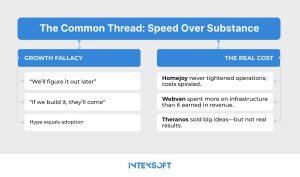
Home cleaning startup Homejoy exploded from 2010 to 2013, raising $40M and expanding across U.S. and European cities. But its firehose growth masked a fizzing foundation: acquisition costs outpaced revenue, worker classification lawsuits mounted, and inconsistent service quality drove churn.
The lesson: without systemized training and disciplined operations, aggressive city-by-city launches become a strategic liability — not an advantage.
Webvan gambled big — building vast warehouses, buying trucks, and targeting “30-minute home delivery” across ten major U.S. markets. Investors pressured it to expand to 26 cities. But the company had nothing to prove its model would work anywhere at scale. Replete with infrastructure but devoid of demand discipline, Webvan burned through $525M in expenses on only $178M in sales, filing for bankruptcy by 2001.
They learned it the hard way: building big before building sustainable is financial self-sabotage.
Theranos was all flash — promises of revolutionary blood tests fueled a $9 billion valuation and intense media attention. But it couldn’t deliver results. Revelations showed reliance on unproven tech and hidden testing failures. The company collapsed under lawsuits, fraud charges, and loss of trust. In dangerous industries, fast without proof isn’t brave — it’s criminal.
IntexSoft has already uncovered what happens when development moves too fast — burnout, broken products, and technical debt that lingers like malware. But speed isn’t the enemy. It’s how you wield it that counts. Smart growth is possible — and it starts with building like you actually mean to scale. Here’s how to move fast without breaking your future.
How to manage rapid business growth?
Rushing to build every feature is a trap. Instead, introduce a Minimum Viable Product — a stripped-down version that tackles a core problem and validates demand. According to Lean Startup principles, an MVP helps you test assumptions with minimal cost and maximum insight.
That’s how startups avoid wasting months on features no one uses — and how they channel velocity into real momentum.
Smart growth is built on automation. When manual tasks accumulate — tests, builds, deployments — you lose speed, consistency, and sanity. DevOps best practices recommend automating CI/CD pipelines to turn repetitive work into invisible infrastructure.
Tools and frameworks make these systems reliable — so you can deploy confidently without firefighting. Turn whimsy into workflow.
Speed without structure fails. Instead, design systems for scale:
True velocity is built on repeatable, improvable, and reliable patterns.
Smart teams ship fast and sustainably. Structure your workflow so it supports — not punishes — velocity:
Fast doesn’t mean frantic — if your culture is purposeful, speed becomes a lever, not a risk.
Too many companies rush to launch without thinking about the long-term impact. When a business is growing too fast, speed often trumps planning — and that’s when cracks begin to show. Technical debt piles up. Teams burn out. Systems break under pressure.
But here’s the truth: moving fast is rapidly becoming a standard way of doing business. The difference between failure and sustainable success lies in how you approach that speed. Real growth means pairing velocity with smart development — solid processes, strong testing, clear priorities, and infrastructure built to scale.
At IntexSoft, we believe smart development means balancing momentum with foresight — engineering with guardrails, not guesswork. If your business is moving fast and you’re ready to make that velocity work for you, our seasoned experts are here to help.
Reach out for a free consultation — and let’s turn your fast pace into lasting progress.


Let’s explore the latest trends and predictions for software development in 2025. Stay ahead of the curve with insights on emerging technologies and industry shifts.

Discover practical steps in 7 tips to create a web portal your users will love.

This article provides an in-depth look at nearshore custom software development, covering its core aspects, benefits, and cost factors.