

If an ecommerce app is in your 2026 growth plan, this article is the place to start. You’ll learn what different app types cost, why prices vary so widely, and where brands accidentally overspend. Need more? Contact IntexSoft anytime.
Reading time: 35 min.
A mobile app is the next logical step in the growth of any ecommerce business. Sooner or later, every online store owner scales up and reaches this point. And then the question appears: “Should I choose a ready-made platform or invest in a fully custom app?” These options are completely different, and the choice is so important that the wrong one can cost the business a great deal.
If you choose ready-made platforms, the first thing to explore is what Shopify, Wix, Drupal, and Squarespace offer. In many cases, one of these platforms will cover the core needs of your store. You also gain the advantage of faster setup. Typically, you can expect to spend under $20,000.
But if you want full customization control and more wiggle room in performance — custom development is the path. And that requires investment. This article uncovers all the nuances of rates.
The danger, however, lies in the details — features you don’t need, decisions made too quickly, and expenses that surface without warning. To avoid those traps, you need clarity on what truly shapes the cost of development.
We’re here to lay out key details.
Here’s what this guide will walk you through:
If you need numbers tailored to your own project, IntexSoft can put together a full technical blueprint, complete cost breakdown, and clear estimate.
Check the latest numbers and you’ll see a major trend. Ecommerce isn’t slowing down anytime soon. Analysts expect global revenue to hit $4.96 trillion by 2030, thanks to a 6.29% annual growth rate. By then, close to 4 billion people will be shopping online — more than half the world — with user penetration reaching 56.4%. And with average revenue per user climbing to $1,130, it’s obvious why ecommerce apps have become the front doors to today’s fast-moving digital economy.
At its simplest, an ecommerce app is a digital storefront built around speed, convenience, and personalization. As the market matured, new structures and categories of ecommerce apps appeared — each suited to different business needs.
You can explore them all in the table below:
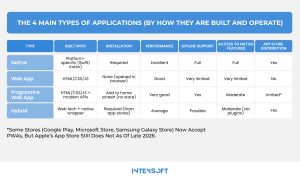
Native apps are written in the language each device (iPhone or Android) trusts most. They offer speed, precision, and unfettered access to the hardware. But none of it comes without a bill. You end up building two separate products that merely look alike. Two platforms mean two builds, two teams, and two trails of code that never meet. And if leadership bets too heavily on one side, they put all of a company’s eggs in one basket without even noticing.
In e-commerce, that choice carries even more weight. Native apps offer smooth navigation and deep integrations with Apple Pay and Google Wallet, but those benefits come with a price. You’re now maintaining two separate codebases.
So assess your resources honestly, without wishful thinking.
This is the second technical configuration to consider.
Anyone determined to avoid doubling their engineering spend should look closely at today’s cross-platform frameworks. React Native and Flutter let developers write one app and deploy it everywhere. These apps may fall a step behind native performance, but only just — and the cost savings are truly hard to ignore.
There’s also a rising star in the ecosystem: PWAs. They run in the browser but perform like full apps — fast, responsive, installable, and light on resources. In markets where limited storage and shaky networks hold users back, PWAs offer a way through. And because they cross devices without an App Store download, they’re opening the door for global e-commerce growth at record speed.
Running underneath all of the above is a quiet revolution: headless commerce.
Instead of locking the frontend and backend together, headless architecture splits them apart. This gives brands the freedom to run a native app, a cross-platform app, and a PWA — all pulling from the same backend engine. Built with modern consumers in mind, it’s flexible, scalable, and ready for shoppers who switch devices constantly and want their journey to stay perfectly synced.
Right now, the most successful brands aren’t choosing between these tools — they’re combining them.
Every part of the stack plays a role in reaching that multi-trillion-dollar market and capturing a share of the rising ARPU.
If nearly four billion people will shop through ecommerce platforms by 2030, which touchpoint — native, web, or cross-platform — will be your primary customer gateway? Is your infrastructure flexible enough to support headless architecture, or will scaling across multiple app types slow you down?
At IntexSoft, we are here to answer these questions and more.

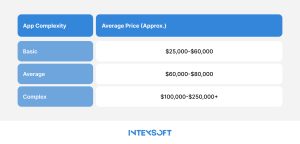
Maybe you’ve done a quick search and plugged your idea into an app cost calculator. Just know: those estimates can be way off.
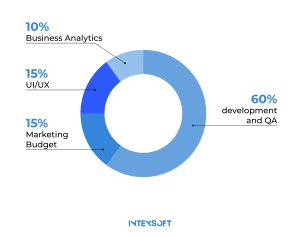
Want to build a ecommerce app that actually wins? Then don’t even think about writing a single line of code until you nail this phase. IntexSoft financial analysts are confident that before a single screen gets designed or a single developer touches code, companies have to run everything through Discovery and Product Strategy.
Here’s why it matters: Too many founders race into development and end up burning through cash on features customers never asked for. Discovery flips that script. A seasoned product team digs into your business goals, studies competitors, maps out your target users, and builds a roadmap that shows exactly what the MVP should include — and what it shouldn’t.
What’s more, another reason that might get you thinking: companies that skip discovery are the ones most likely to miss deadlines, inflate budgets, or launch something no one uses. The businesses that invest in this phase usually roll out faster, cleaner, and with fewer surprises.
Discovery typically accounts for 10–15% of the full budget to build an e-commerce app. That’s roughly 20–200 hours of strategy work, costing $5,000–$40,000, and usually wrapping in 1–4 weeks.
After discovery sets the direction, UX research and information architecture shape the blueprint of how customers will actually move through your app. At IntexSoft, we see the same pattern again and again: the apps people love aren’t the flashiest — they’re the ones that make every action feel natural.
Here’s why this stage matters:
Before designers build screens or developers join the project, UX researchers dig into real user behavior. With this foundation in place, your app begins to attract users because it simply makes sense.
What this phase helps you achieve:
What’s more, here’s another reason that might get you thinking: companies that try to skip UX research often end up redesigning half their app later — costing more and delaying launch.
This stage accounts for a quiet but decisive 20–25% of an e-commerce app’s total budget. Costs may vary significantly, ranging from $5,000 to $50,000.
If Discovery sets the direction and UX shapes the experience, the backend is where your entire e-commerce engine actually comes to life. And when companies ask what drives the ecommerce app development cost, this is the biggest piece of the puzzle.
The backend is the system that keeps all of this moving, reliably and at scale:
Companies that cut corners on backend development often pay the price twice — once during launch when performance tanks, and again months later when they’re forced to rebuild it properly.
Backend development typically makes up a large share of the ecommerce app development cost, often landing between 25–40% of the total budget. Depending on the complexity of the catalog, search logic, checkout rules, and payment integrations, this phase can run 4–16 weeks and cost $10,000 to $80,000+.

Once the backend engine is running, it’s time to build the part your customers actually see — the mobile and web frontends.
Here’s why it matters:
A polished frontend can make or break your e-commerce app. The frontends — whether iOS, Android, web, or a PWA — are the storefront your customers judge instantly.
What frontends unlock for your users:
What’s more, here’s another reason that might get you thinking: Most e-commerce brands don’t invest in just one interface. They build a couple — usually a web storefront and one or two mobile versions. That multiplies the importance of consistency, performance, and clear communication between teams.
Mobile and web frontends typically account for 20–30% of your total e-commerce app budget. Depending on the number of platforms, animation complexity, screen count, and performance expectations, this phase can cost $10,000–$70,000+ and take 4–12 weeks.
On this stage, your e-commerce app stops being just a storefront and becomes a fully connected business engine. And that being said, it’s also where many companies underestimate both the complexity and the price.
Integrations turn on advanced functionality:
Integrations typically account for 15–30% of your total e-commerce app development cost. Depending on the number of systems, API complexity, vendor documentation, and required customization, this phase can range from $10,000 to $100,000+ and take 4–16 weeks.
On this stage the QA team checks your app across devices, operating systems, screen sizes, and real-world conditions. Add test automation to the mix.
This approach lets you:
This stage typically makes up 15–25% of the full e-commerce app development budget. That’s usually 100–500 hours of manual and automated testing, ranging from $8,000–$60,000, depending on complexity, number of platforms, and how extensive your automation suite needs to be.
| Choice | Why Teams Pick It | What It Usually Costs |
| Native iOS | The Apple environment — controlled, exacting — offers performance that leaders trust when stakes rise. | $20,000–$80,000 |
| Native Android | Teams invest here when scale — not uniformity — is the mission. | $18,000–$75,000 |
| Cross-Platform | Here the argument centers on efficiency. One build, two platforms, fewer unknowns. It’s a calculation that often wins out when time is thin. | $25,000–$90,000 |
| Web Apps & PWAs | This choice reflects a certain pragmatism. No store approvals, no delays — just direct access to the customer, on demand. | $10,000–$30,000 |
| Headless / Composable Commerce | It’s chosen when innovation must override constraints. | $40,000–$150,000+ |
| Monolithic Architecture | Leaders opt for it when predictability matters more than experimentation. It’s a structure that keeps operations steady, even when markets shift. | $15,000–$60,000 |
The cost of creating an ecommerce website or a full-scale mobile app can vary widely. The push toward custom ecommerce app development has intensified as brands try to stand out, scale faster, and conquer rising customer expectations. But what truly drives the final price tag? And which choices could open the door to long-term flexibility — or lock a business into expensive overhauls later?
Let’s break the total investment into clear cost centers.
This often takes up the biggest slice of the pie. MVPs keep things lean, but once you bring in personalization, automated subscriptions, loyalty engines, complex sales promotions, or a full marketplace layer, the cost jumps quickly. Each feature works like installing another server rack in your cloud—heavy power, heavier price.
And here comes the first big question: How deep should your first release really go? Many founders rush to include “everything,” but well-planned sequencing often saves millions (both old and new). Teams agree with this argument.
A small product catalog with simple rules costs far less than a massive, multi-category catalog with dynamic filters, AI-powered search, or complex variant logic. Retailers with thousands of SKUs soon discover that catalog architecture behaves like a database engine under load: elegantly simple when small, wildly demanding at scale.
Which leads to a second question: Do you need advanced search on day one — or only once traffic demands it?
This covers everything from payment processors to ERP, CRM, PIM, tax engines, and logistics providers. Each integration is a tunnel between two systems, and some tunnels require far more engineering than others. The more you stack, the more your environment starts to resemble a sprawling API highway.
But ask yourself: How many integrations truly matter for launch, and which ones can come later?
PCI compliance, GDPR readiness, data encryption, and fraud defense add meaningful cost. Security is the firewall that keeps your brand standing when threats escalate. Cutting corners here is rarely wise.
The important question: Are you budgeted for today’s risks — or tomorrow’s?
An app built for moderate use is one budget line; an app built for Black Friday chaos is another. It requires real engineering muscle — load-testing, smart caching, autoscaling environments, and guaranteed uptime. Reaching those SLAs calls for infrastructure that operates like a distributed cluster — responsive, tough, and restless.
And here we hit another key question: What level of performance do your customers actually expect — and what happens to your cost profile when those expectations rise?
A seasoned brand expects the fine details — spot-on pixels, strict motion guidance, and UX flows that are built with discipline. Younger brands, still finding their voice, generally offer a wider creative lane. The gap between “clean and functional” and “fully art-directed” can add weeks or months.
So here’s another question worth asking: Do you need world-class design now — or simply a version that works well until brand maturity evolves?
You’ll pay more for senior engineers, but their output is faster and far more predictable. The delivery model adds another variable: nearshore partners, offshore operations, hybrid systems, or fully internal teams. Each model affects cost, communication rhythms, and risk levels.
Building an app comes with more than a few financial surprises, and some of them can hit harder than you expect. Here are three of the most common money traps — and how to keep them from blowing up your budget.
The good news: there’s a reliable way to dodge these traps — strong documentation.
When business analysts, system analysts, and stakeholders spell out every requirement early, you reduce surprises later. No sudden turns. No costly additions. And a much better chance of staying on budget.
Here are a few smart ways to nail your documentation from the start:
Every business wants a great app, but no one wants runaway costs. And the reality is, budgets don’t explode because development teams are careless — they explode because expectations shift, requirements weren’t aligned, or the contract left too much room for interpretation. Controlling your budget starts long before coding begins.
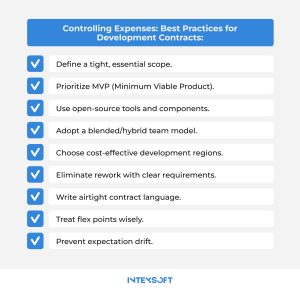
Begin by mapping out your flex points. Quality should remain solid, but schedules and features can shift when needed. Many companies make the mistake of chasing every idea at once, only to discover they’ve paid for a product bloated with features users never touch. A tight scope is your strongest financial defense.
To keep development costs steady, focus on a few proven strategies. First, strip your app to the essentials. Identify the core functionality your product absolutely cannot launch without. Everything else can be pushed into later phases once your app proves itself.
From there, look for ways to streamline development. Open-source tools are one of the easiest wins. They give teams access to secure, well-tested components for free, reducing both build time and risk. Your developers don’t need to custom-create every button, form, or integration.
Another proven route: a blended team approach. Send most development to a dependable, cost-efficient region. Keep a compact crew inside your company to run strategy, oversee QA, and guide the product. The model saves money and still delivers strong results.
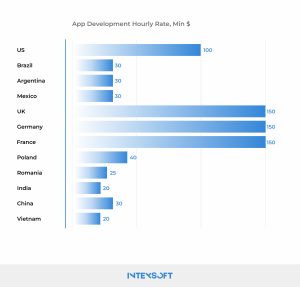
As we have mentioned above, one of the biggest budget killers is rework — and most rework comes from unclear instructions. Before developers begin, make sure every stakeholder, legal advisor, and compliance expert reviews the requirements. A single missing approval can lead to costly — and preventable — revision cycles.
The contract needs to reflect the seriousness of the work. Write it as if you’re putting up a skyscraper — deliverables laid out, redesigns controlled, approvals tied to every level, and communication orchestrated from a single point. Clear expectations keep the structure strong and costs from spiraling.
Online sellers are weighing three routes: pave their own road, take the well-built highway of Shopify or Magento, or choose a hybrid path where SaaS momentum meets custom freedom.
| Option | Cost | Speed | Flexibility | Best For |
| Buy (Shopify/Magento/BigCommerce) | ★ Low | ★★★ Fast | ★ Limited | Startups, midsize stores |
| Build (Headless/Custom) | ★★★ High | ★ Slow | ★★★ Unlimited | Enterprise, global brands |
| Hybrid | ★★ Medium | ★★ Faster than custom | ★★ High | Growing brands, omnichannel retailers |
For ecommerce leaders, these platforms offer a clear path. Shopify, Magento Open Source, and BigCommerce bring hosting, security, and prebuilt features that act like a well-lit runway guiding a plane toward takeoff. But what happens when the market shifts, and your roadmap stretches thin? And will these choices still hold when unexpected costs surface?
Best for brands that need absolute control, unique experiences, or plan to scale globally.
Going fully custom — often with a headless architecture — puts your development team in the driver’s seat. You can create storefronts for web, mobile, IoT, in-store screens… anything your experience demands.
But this freedom comes with higher costs and longer timelines.
Best for teams that want the speed of SaaS and the differentiation of custom development.
The smartest ecommerce teams aren’t forced into an either-or decision anymore. A hybrid model allows them to adopt proven capabilities — catalog management, checkout, CRM, analytics. They reserve in-house development for the differentiators that fuel growth.
In a market where ecommerce mobile app development cost can swing dramatically from project to project, many companies want a partner who has seen almost everything going in the digital retail world.
That’s where IntexSoft steps in. With more than 120+ delivered ecommerce cases, a portfolio that spans B2B stores, global marketplaces, and complex migrations, the team has spent years refining an approach that helps other businesses scale without chaos. But what makes the company’s delivery model worth examining early on?
For starters, IntexSoft is built around Agile practices — Scrum, Kanban, and hybrid models — designed to give clients wiggle room as requirements evolve. The team uses short sprints, weekly demos, and transparent reporting so stakeholders don’t see surprises at the end — they see them together in real time. And the philosophy is simple: when you reduce uncertainty, you reduce cost.
IntexSoft’s experience stretches across Magento, Shopify, Drupal, WordPress, and fully custom stacks. You can learn more in our blog.
Case studies show those choices matter. Take the B2B Online Store built on Magento, or the highly performant web app created for Parfuemerie.de — both spotlight how strong engineering and disciplined UX work can transform digital operations. Full details are available in the company’s public portfolio.
IntexSoft offers three collaboration models — dedicated teams, full-cycle project delivery, and team augmentation.
If you’re ready to talk through your needs, our team is available anytime.


The article explores AI's impact on ecommerce, highlighting its role in enhancing customer experiences and driving revenue.

This article highlights the top 10 eCommerce development companies to watch in 2026 across the U.S. and Europe.

Blockchain technology is revolutionizing the ecommerce industry, providing increased security, transparency, and efficiency for online transactions. In this article, we discover how businesses are leveraging blockchain to streamline operations and build trust with customers.