Hyper-Personalization in eCommerce: Benefits, Examples, and Why It’s a Game-Changer
Business
Design & Marketing
E-commerce development


Learn how hyper-personalization in eCommerce uses AI, predictive analytics, and customer data to increase conversions, loyalty, and customer lifetime value. Explore strategies, examples, and best practices for retailers.
Reading time: 22 min.
Basic personalization, including a “you might also like” recommendation, no longer moves the needle. The shift is toward hyper personalization in retail, where customer interactions become more relevant at every touchpoint.
Think about a shopper browsing skincare products. Recommendations adapt in real time, and offers become more relevant. The system picks up on subtle signals, recognizing whether a shopper gravitates toward European or South Korean products, which brands they favor, their typical price ranges, and age-related preferences. The experience starts to feel more personal, almost conversational. Behind it sits a mix of machine learning, AI, and behavioral analytics.
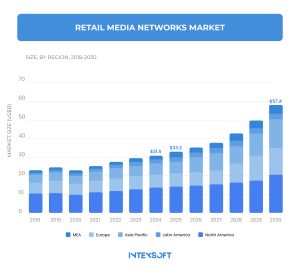
The Asian market already points to the future of ecommerce. Platforms such as Alibaba’s Taobao combine entertainment, hyper personalization, and endless scrolling to create immersive shopping experiences. Western retailers are still catching up.
The importance of personalization in eCommerce goes beyond better product recommendations. According to Boston Consulting Group research, retailers building more adaptive customer experiences tend to see stronger revenue performance (up to 10% growth) and create a widening gap between themselves and less personalized competitors. In some cases, they outperform them by two or even three times. With Customer Acquisition Costs (CAC) up 222% over the last eight years, turning casual browsers into returning customers is a matter of commercial survival.
| Criteria | Personalization | Hyper-Personalization |
| Data Usage | Primarily historical data | Real-time data + historical context |
| Modeling Approach | Based on heuristic rules and broad segmentation | Uses AI/ML-driven predictive models with real-time behavioral analysis |
| Response Time | High latency, updates typically occur once per session or daily | Millisecond-level decisioning triggered by current user actions |
| Interaction Nature | Reactive | Proactive |
| Target Audience | Broad groups or segments | “Segment of one” |
| Context Sensitivity | Limited | Advanced |
At IntexSoft, we explore what it takes to move beyond personalization 1.0 and build something radically smarter.
Hyper personalization in ecommerce starts with data. A lot of it. To build a high-definition map of customer intent, online retailers must rely on the following data streams:
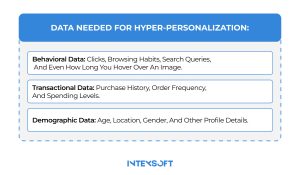
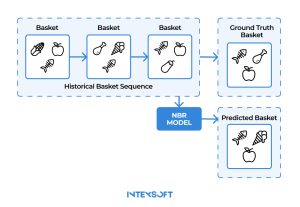
This level of intelligence depends on modern infrastructure. At the center is a Customer Data Platform (CDP) acting as a single source of truth, bringing fragmented customer data into one space. Machine learning models, including Next-Basket Prediction (see illustration below), can forecast what a shopper is likely to need next and when they are most likely to buy. Activated through flexible APIs, these datasets allow retailers to adapt the shopping journey instantly.
A personalized ecommerce experience at this level comes with two realities.
Why does ongoing investment matter? Customer behavior changes. Without regular tuning, even strong models begin to lose accuracy as model drift sets in.
But performance creates another challenge – trust. AI-based recommendations can skyrocket order value by up to 369% when done right. Yet relevance without transparency creates a different kind of risk. Personalization starts to feel less helpful and more invasive.
Shoppers say they trust brands more when customer data use is explained clearly. That’s why hyper-personalization without transparency risks something harder to recover: the erosion of customer trust.
To make GDPR an asset rather than a constraint, IntexSoft recommends retailers develop ecommerce experiences around a Privacy-by-Design architecture:
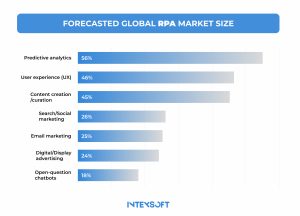
AI is helping online shops move beyond classic segmentation into a new era. Teams no longer think in broad categories such as “women aged 25-35.” Instead, they build strategies around a “segment of one,” where each user journey is unique and calculated individually.
Here is how leaders are turning data into relevance at scale:
| Example | What It Does | The Bigger Picture |
| Targeted Social Media Content | Algorithms filter what appears in customer feeds based on clicks, searches, and viewing behavior, and even pauses on a video. | Feeds become increasingly shaped by predicted intent rather than random discovery. |
| Personalized Product Recommendations | Purchases and searches help anticipate what a customer may want next. | The retailer gains an edge by getting to customers before they even make a decision. |
| Custom Loyalty Rewards | Rewards adapt based on spending patterns, timing, and purchase behavior. | Personalization helps strengthen retention and repeat purchases. |
| Location-Based Discounts | Discounts appear when customers are near a store, triggered by location data. | Real-time location becomes a conversion lever. |
| Personalized Customer Service In-Store | Store associates can access purchase history and likely preferences. | Service becomes more contextual and relevant. |
| Dynamic Pricing | Prices adjust based on demand, competition, and what the system predicts customers are willing to pay. | Pricing becomes a continuous optimization process. |
Leading brands were among the first to read the direction of the shift and quickly adapted their storefronts to the “segment of one” standard. They implemented nearly every capability outlined in the table above. Some went even further. Let’s look at the cases of Sephora and Nike to show how deep personalization can multiply ecommerce profit.
Three years at the top of the Retail Personalization Index is not an accident. Few ecommerce brands have taken individualized experiences this far. Today, the company’s “Beauty Hubs” collect biometric data that flows directly into customer profiles and powers personalization across the website.
It starts with Beauty Insider, the flagship loyalty program – arguably the foundation of what made Sephora, Sephora. Today, according to Forbes reporting, the program has grown to more than 46 million participants and drives 82% of all transactions. Sephora’s advantage comes from repetition. Every click, purchase, and store visit feeds into a Customer 360 profile that becomes smarter over time. As recommendations grow more relevant, Beauty Insider participants end up spending twice as much as non-members. Ecommerce gamification reinforces customer engagement through loyalty rewards. Clients do not just use the program, they love the experience it creates.
The Customer 360 model is enhanced by Virtual Artist, an AR-powered feature developed in partnership with ModiFace. As a result, users completed more than 200 million virtual try-ons and were three times more likely to make a purchase. Average app session time also increased from 3 to 12 minutes. Just as importantly, Sephora reduced one of ecommerce’s biggest cost drivers: product returns dropped by 30%.
The brand continues to expand hyper-personalization in beauty retail. Tools such as Skin IQ and Color IQ bring scalable diagnostics to online shoppers: neural networks trained on more than 40 million dermatology images process up to 200,000 sessions each week. The system addresses shade matching, a challenge faced by many women.
Sephora’s AI agents are in a different category from traditional customized chatbots. Connected to data from millions of Beauty Insider members, they autonomously handle 40% of routine workflows, instantly resolve up to 80% of incoming requests, and reduce response times by nearly 40%. But the bigger shift is commercial: agents have evolved from support tools into revenue-generating touchpoints. Since March 2026, Sephora has expanded this model through ChatGPT integration. Loyalty members in the United States can now get personalized recommendations and shop directly in chat.
Nike embraced an AI-native model long ago and evolved into a fully connected digital ecosystem. Ecosystem is the right word here. Instead of relying on a single “super app,” the brand built a portfolio of specialized platforms, including Nike App, SNKRS, NRC, and NTC. Together, they reach more than 170 million users.
One login ties together Nike’s ecosystem (apps, website, and physical stores) into a single identity resolution layer. This allows the company to build the same Customer 360 profile we saw earlier in Sephora’s case. That means the model is not beauty-specific. It can be replicated across almost any industry.
Apps such as NRC and NTC monitor activity levels and recommend new footwear based on real product wear and running patterns.
Biometric technologies work especially well in Nike Fit, where computer vision and machine learning work together to scan feet with accuracy down to 1 millimeter. Realistically, this difference is unlikely to affect fit, so customers can stop second-guessing their size. But this is only one side of the coin. Millions of users upload unique biometric data into the system. Nike analyzes these insights to refine future product lines and improve fit at scale.
The brand knows which customers are worth acquiring and how much to invest in reaching them, thanks to predictive analytics. Algorithms help spot local demand before it becomes obvious based on a cross-section of user behavior, preferences, and regional buying patterns.
If interest in a sneaker model begins to spike online, Nike can move that product into nearby stores before customers even place an order. ZIP-code-level signals then shape inventory at each physical location.
Yes, building this kind of system required multi-billion-dollar investments. The good news? Retailers no longer need Nike- or Sephora-level budgets to benefit from the same principles. In 2026, technologies that once felt exclusive are now widely accessible.
The trigger was the rapid growth of SaaS platforms, which opened the door to predictive analytics even for ecommerce businesses generating around $5M in annual revenue. As a result, entering hyper-personalization now costs significantly less than building a Nike-style system from scratch.
At IntexSoft, we invite online retailers to experience the full power of the Pareto 80/20 principle in action. By implementing just a handful of automated triggers (20% of the effort), businesses can close the biggest gaps in the sales funnel and capture up to 80% of the value hyper-personalization can deliver.
IntexSoft begins with what we call a “quick wins” phase – minimal effort on your side, fast ROI for your business. And yes, we mean fast: measurable results can appear within the first month. To make this happen, our ecommerce developers immediately implement three high-performing trigger mechanisms:
By month one, hyper-personalization often starts paying for itself. Early gains create the financial foundation for more advanced models that IntexSoft can plan over future iterations. Here’s what we see repeatedly: once ecommerce brands experience measurable upside, they typically continue building on it.
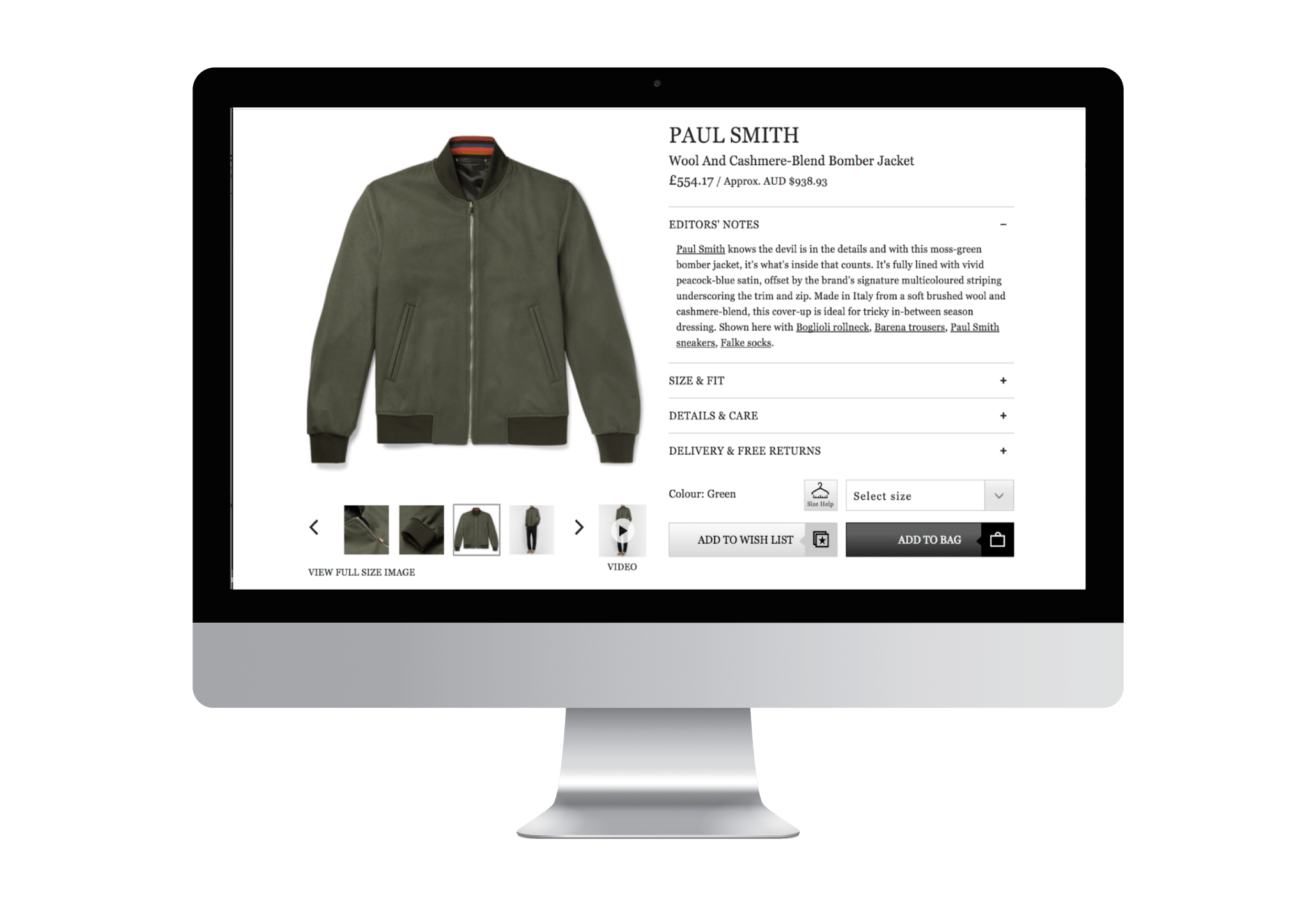
Retailers using hyper personalization in marketing are increasingly outperforming one-size-fits-all approaches because customer data becomes actionable insight only when businesses know how to act on it.
Most retailers follow six core steps to make this strategy work:
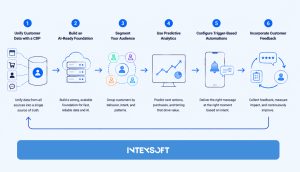
The first priority is operational: break down silos. As discussed above, customer data has historically been fragmented across systems, with browsing behavior in one place, purchases in another, and demographic profiles stored elsewhere.
When this data stays fragmented, AI models train on an incomplete picture of the customer. Personalization begins to fail, and loyal customers are treated more like first-time visitors. A Customer Data Platform solves this problem by creating a single source of truth.
A personalized ecommerce experience can feel almost effortless to the customer. Behind the scenes, it is anything but. If the infrastructure is weak, the entire system starts to break down. A “vanilla” setup – slow data pipelines, disconnected systems, and tools that cannot handle growing demand – quickly turns personalization into friction. As a result, businesses face wasted budgets, slower execution, and disappointed customers.
Strong infrastructure requires:
At this stage, move beyond one-dimensional categories such as age, gender, and region. Instead, two approaches should be applied simultaneously:
New visitors see personalized landing pages tailored to the traffic source, for example, sustainability-focused content for users arriving through searches such as “eco-friendly products.” The system remembers what resonates with the shopper, including preferences for natural ingredients or products not tested on animals.
Segmentation can also use dynamic social proof and product comparisons to identify more specific customer preferences. For example, shoppers motivated by practicality may see stronger emphasis on durability, longevity, or economical product use.
Above, we covered segmentation approaches used before purchase, but at IntexSoft, we also segment customers after the sale. Here, replenishment cycles become very important. The system helps identify customers whose purchase frequency is beginning to decline and enables predictive intervention before they move to a competitor. We will cover this in the next section.
Instead of locking shoppers into endless recommendations for similar products, AI-powered predictive analytics identify the next action most likely to bring them back to your online store.
Time-based patterns matter most, especially purchase cycles and replenishment timing. Businesses can predict not only what a customer is likely to buy next, but also when they are most likely to make the purchase. For example, if a shopper regularly orders the same facial cleanser every three months, the system can step in before the product runs out with a reminder, a discount, a personalized “3 for 2” offer, or samples linked to products sitting in the cart.
At this point, IntexSoft uses real-time customer scoring and micro-segmentation, helping businesses:
Insights matter, but action matters more. That is why omnichannel ecommerce orchestration is important. At IntexSoft, we focus closely on this layer to help retailers activate customer signals when intent is highest.

For more than 20 years, we have been building solutions for the ecommerce industry and advising retailers of all sizes. Today, RCS consistently ranks among our top recommendations. According to the 2026 Global Customer Engagement Review, this channel can increase sales by up to 6.5x when implemented correctly. So what makes it work?
Consumers tend to welcome RCS: more than half of shoppers see proximity-based promo offers as useful rather than unwanted advertising. Operator-verified messages receive especially high levels of trust and approval.
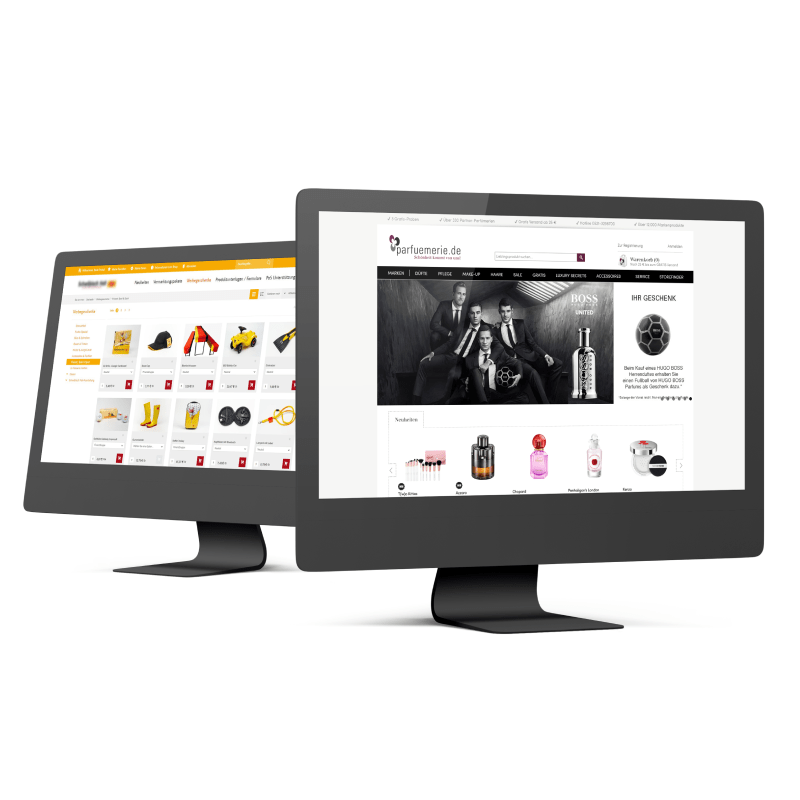
It is worth noting that this approach performs best when AI coordinates actions across four or more channels simultaneously, including email, SMS, RCS, and push notifications.
The final step is often overlooked. Feedback loops (ratings, surveys, reviews) act as a reality check against algorithms. They reveal whether personalization feels relevant or intrusive. Retailers that listen adapt quickly; those that don’t lose trust.
And don’t forget the human factor. AI can scale personalization, but it cannot replace empathy. For high-stakes situations – billing disputes, health concerns, complex service requests – human oversight remains non-negotiable.
Finally, if you cannot build all this in-house, choose partners who understand both the engineering and the ethics. Privacy, consent, and data ownership are not side notes.
The secret behind the importance of personalization in ecommerce lies in the mix of technologies that can read signals, interpret intent, and respond immediately.
What does this stack look like in practice?
The result? Customers no longer see personalization and customization as a nice-to-have. They begin to expect a shopping journey that feels more intuitive and increasingly tailored to them. You can also read our article on how to benefit from AR/VR technologies in ecommerce.
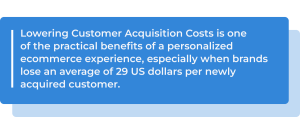
McKinsey & Company’s numbers are striking: customer acquisition costs cut in half, revenue gains in the double digits, ROI up by nearly a third. Some companies, by rejecting one-size-fits-all, have seen growth surges as high as 25 percent. The story is about precision. And the consequence is market control.
Think of these key benefits for ecommerce business:
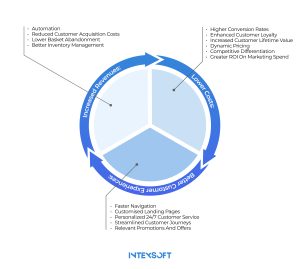
Few companies see the full picture. Credit card issuers may know where customers shop, but not what they buy. Social platforms track clicks but often miss conversions. Search engines capture intent but rarely the final purchase. Hyper personalization retail starts with a unified customer view, helping brands scale more effectively and expand to global markets.
Still looking for arguments in favor of hyper-personalization?
Yes, 96% of retailers struggle to implement personalization due to disconnected data. With more than 20 years of experience, IntexSoft builds Customer Data Platforms that create a single source of truth by unifying behavioral and transactional signals in real time. This gives retailers a path toward Level 4 (AI-Native) maturity, where revenue per visitor is typically 2.4x higher than with basic personalization approaches.


Dive into stats, smart global expansion tips, and e-commerce platforms that are dominating the international game.

In this article, IntexSoft takes a closer look at the power of business intelligence tools.

This article highlights the top 10 eCommerce development companies to watch in 2026 across the U.S. and Europe.