Custom vs. Template eCommerce Platforms: Pros, Cons, and How to Decide
Business
Design & Marketing
E-commerce development


You’re looking at a crossroads. One path – off-the-shelf templates – is fast, cheap, and familiar. The other? It’s a custom. Crafted just for your e-commerce business. In this article, we will walk through both sides. You’ll see the pros, the cons – clear, unvarnished. Need more information? Contact us anytime for a free expert consultation.
Reading time: 12 min.
Custom website design is about building a digital storefront brick by brick – designed around a business, not squeezed into a one-size-fits-all mold. In eCommerce, that difference is often decisive.
Custom design is deliberate. Every line, every feature built for your business. It begins with the truth – knowing your customers. Where they stop. Where they decide. Where they act. From that evidence, designers and developers create a system that supports you. Not one that stands in the way.
The facts tell a story. According to HubSpot, 93% of consumers say a positive user experience makes them more likely to purchase again. Another study shows that low conversion rates push 80.8% of sites to be redesigned with a custom approach.
At IntexSoft, we are confident: when you own the design, you own the experience.
Now, let’s look at all the pros and cons.
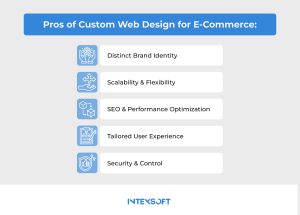
More than 75% of users judge credibility by design. The record is clear: a custom website template design does not blend in. It is built pixel by pixel. It reflects the voice, the values, the identity of the brand.
Ready to evolve? Custom design websites adapt. Add new features, pages, or modules without clashing with preset templates. Your e-commerce platform grows with you.
Search engines account for over 68% of online experiences. A custom site can be optimized from the architecture up – clean code, fine-tuned metadata, fast loading – helping you win the rankings.
A custom build responds to the real needs of your shoppers – intuitive navigation, branded interactions, smoother checkout. The result? A loyal customer who converts more often.
Unlike templates, custom designs allow for bespoke security – your code, your backend, your updates. It’s about prevention, ownership, and long-term governance.
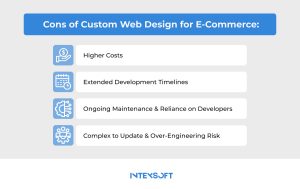
Custom design comes at a price. You’re investing in craftsmanship, not convenience. Budgets can run into thousands.
Patience is the price. Unlike a plug-and-play template, a custom build demands time. Weeks become months. Planning, design, development, testing – it accumulates. That’s the reality of custom website design templates.
You’ll need a trusted partner to update and maintain your code. That long-term dependency is real – and unless managed, can become costly.
Too much custom work can bog down future updates. New features? Edits? You’ll pay in time and complexity. And if you over-customize, you risk complicating the UX.
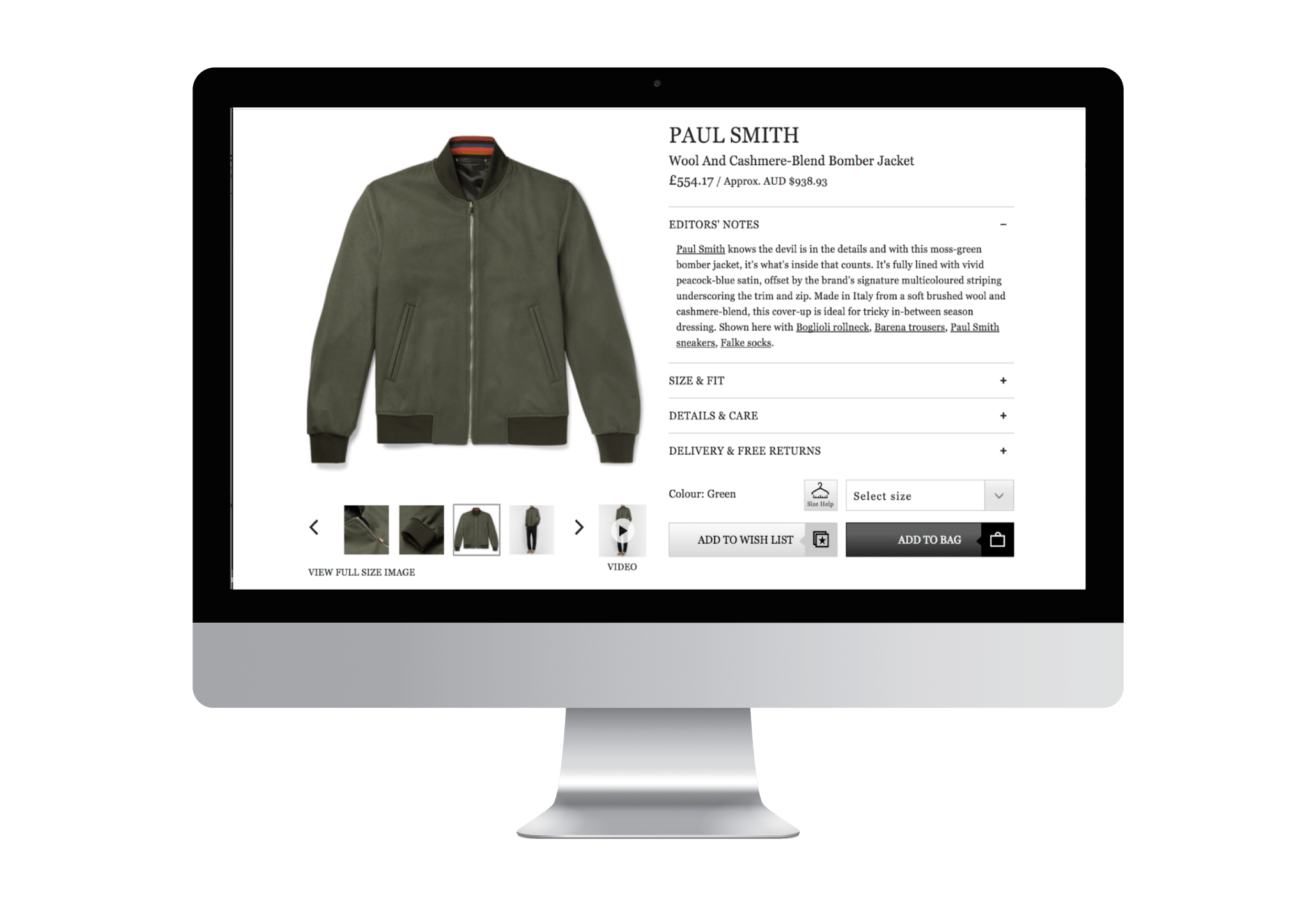
A website template is the opposite of a custom design. It’s pre-made. Templates don’t start from scratch. They arrive with the scaffolding already in place – “About,” “Contact,” even 404 pages styled and waiting. Fonts, colors, buttons – they’re set. The job left to you is content.
But there’s a catch. Many platforms lock you in. Switch templates and you risk losing every word and image. That makes the first choice a lasting one, not something to rush.
When we take eCommerce, not every template is built for this purpose. The wireframe models may give you more room to maneuver, but even they carry restrictions. If a well-designed online store is the goal, the checklist must be clear from the start: carts, product pages, and checkout. Without them, you’re patching holes instead of building momentum.
The market of possible options is vast:
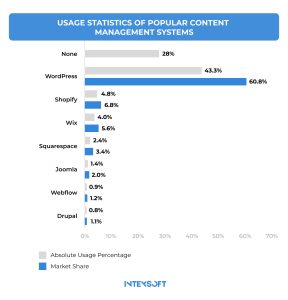
As you can see from the diagram above, WordPress alone powers over 43% of all websites worldwide. Its template marketplace, ThemeForest, lists more than 12,000 website templates. Platforms like Wix and Squarespace give business owners hundreds of drag-and-drop templates, aiming for speed and simplicity.
But the story of templates has two sides.
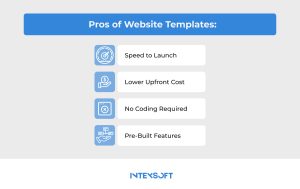
A business can move from idea to live site in less than a day. More than half of small business owners rank “getting online fast” as their top digital priority. Templates deliver that.
Many templates cost under $100. Thousands are free. For a bootstrapped entrepreneur, that’s oxygen. 47% of small businesses cited budget limits as their biggest obstacle to building an online presence. Templates allow them to test, experiment, and pivot without financial shock.
Templates changed the entry point. Drag-and-drop made the barrier vanish. Non-technical founders, once locked out, walked in. They didn’t need to learn code. Platforms – Wix, Squarespace, WordPress – opened the doors. And with custom web design templates, the choice became not if, but how far to go.
Built-in SEO plugins, eCommerce checkout pages, blog modules, mobile responsiveness – all are part of the package. You can open an online shop with secure payments, shipping calculators, and customer reviews by nightfall.
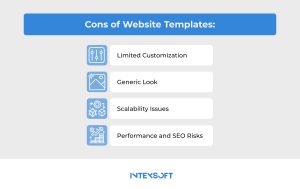
The fingerprints of their origin are always visible. Templates bend only so far. Beyond basic tweaks, true customization often requires a developer’s hand – and that’s where the bills start piling up. Businesses find themselves trapped: locked into a design that isn’t truly theirs, or paying a premium to break out.
If you’re using a popular template, thousands of other websites are using it too. Branding fades into the background. The “stand out” factor, so critical in a crowded online market, evaporates. Users can stop engaging with a website if the content or layout feels unattractive or unoriginal.
Templates solve the “today” problem but rarely the “tomorrow” one. As a business grows, demands expand: custom integrations, advanced analytics, personalized user flows. Many templates can’t handle that complexity. The result? Companies face the disruption of a costly migration or redesign – often right when momentum is strongest.
Performance is not cosmetic. Google’s research shows that 53% of mobile visitors abandon a site if it takes more than three seconds to load. Many templates, bloated with unnecessary code and plugins, fail this test. The promise of convenience becomes a penalty: slower sites, lower rankings, and lost customers.
Look at the concise table below to get the whole picture of custom design and template design for online stores.
| Factor | Template | Custom |
| Time to Launch | Fast – can be live in a day | Longer – weeks to months |
| Budget | Low upfront (free to ~$100+) | High upfront ($5,000–$50,000+) |
| Customization Needs | Limited to pre-built options | Full freedom to tailor every detail |
| Scalability | Struggles with complex growth | Built for expansion |
| Branding & Uniqueness | Risk of generic look, used by thousands | Unique, brand-focused design |
| Functionality & Features | Standard, may require plugins | Custom, advanced features possible |
| Maintenance & Updates | Handled by template provider | Requires in-house or agency support |
| SEO & Performance | May suffer from bloated code | Built to enhance speed and climb the search rankings |
| Tech Knowledge Demand | Minimalist and highly accessible via drag-and-drop | Requires skilled professionals |
Custom design is about control. A site built this way carries your brand’s story, defines the customer’s experience, and positions you in the market. The facts are plain. It costs more. It takes more time. It demands constant attention. But when it’s done right, the result is a platform that is yours alone – built to perform at that level.
Templates, by contrast, are about pragmatism. They save money. They move fast. Most let you adjust fonts, colors, or layouts globally with a few clicks. That efficiency matters when resources are thin. But the risk is sameness. Free templates often feel generic. Paid ones add polish and features, though prices can stretch into the thousands. Third-party templates can feel like freedom. More options, more tweaks. But tread carefully – compatibility can break, support can vanish, and updates don’t always arrive.
Sometimes there is no failure in starting with a template. For a founder testing an idea, it’s common sense. But for a business that intends to scale, that depends on brand identity, that demands performance – the template ceiling shows quickly. At that point, custom is a requirement.
Here’s the truth that matters: the choice between custom and template shapes the trajectory of the business itself. Decide with clarity, grounded in priorities – not in the myth of shortcuts or the fear of upfront costs.
Custom design offers control, originality, and the long game. Templates deliver speed, lower cost, and an immediate presence. IntexSoft has seen both realities play out. Whichever direction your business takes, the support is there.
Our design team, with deep experience in eCommerce, stands ready to build custom solutions. The same team knows the template landscape – where the trade-offs are, which choices work best, which to avoid. The experience is layered, practical, and proven. The company’s blog holds more details. The experts, when asked, respond with direct answers.
Contact us anytime.

Today, user experience (UX) design is about more than just user interaction and interface sketches related to usability and technology. UX is an integral part of business strategy, project lifecycle, and post-product development.
The interesting thing about any crisis is that it accelerates some trends and can root those afterward. After weeks of monitoring the impact of COVID-19, we’re looking at the future and wondering what comes next.

Let’s explore the latest trends and predictions for software development in 2025. Stay ahead of the curve with insights on emerging technologies and industry shifts.