Live Streaming Commerce Simplified: Best Practices and Platforms for Retailers
Business
Design & Marketing
E-commerce development


In this article, IntexSoft makes the complex practical. We break live commerce down component by component, from technology stack decisions and KPI analysis to a roadmap that guides retailers from an initial pilot all the way to AI-powered scale. Read on to learn how to turn customer attention into sales.
Reading time: 25 min.
Anyone who remembers the home shopping boom of the 1980s will recognize live streaming commerce as its digital successor. The concept is familiar, but today’s experience is built for a mobile-first generation, with 76% of livestream viewing taking place on smartphones.
According to a Forbes article, live commerce delivers conversion rates up to 10 times higher than traditional ecommerce. It turns product selection from a utility into a spectacle. The brands that entertain are increasingly the brands that sell.
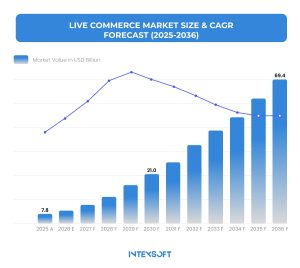
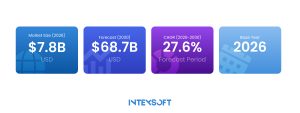
Yes, this is the borderless market in its purest form. Thanks to automatic subtitle translation, much like YouTube’s, and multi-currency payment infrastructure, your store can sell to customers across continents, time zones, and languages. The entire world is now your addressable market.
And the center of gravity is not in the West. It is in the East. The Asia-Pacific region has led the livestream shopping software market for more than a decade and is projected to maintain its dominance with more than 54% of global market share:
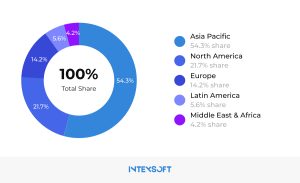
The center of gravity may be in the East, but the next wave is spreading westward. The U.S. and European markets are expected to grow at nearly 20% CAGR as retailers translate Eastern live streaming commerce tactics into Western buying journeys.
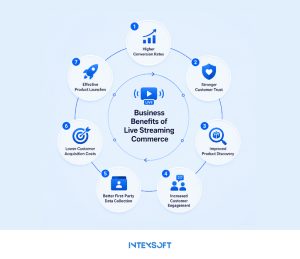
The secret behind interactive ecommerce – and much of its magic – is hyper-personalization in motion. Classic ecommerce tells customers what to buy. Live streaming retail shows why it matters through real-time interaction, product demos, and instant feedback. That is exactly what makes the first benefit in our list possible: deeper audience involvement and a buying journey customers are more likely to remember.
When it comes to influencer live shopping engagement metrics, authenticity wins. If trusted creators demonstrate products in real time, the interaction feels more credible than ordinary advertising. Real-time Q&A also removes common purchase barriers: “Will this work for sensitive skin?”, “How does it compare to the previous version?”, or “Is this true to size?” Customers resolve doubts instead of leaving the session to search elsewhere. Trust follows naturally.
And that’s why live streams significantly outperform pre-recorded videos on engagement – in some cases by up to 10 times. Viewers also tend to stay three to five times longer, giving brands more opportunities to educate, interact, and convert.
Let’s address what matters most to your business: sales. Across live shopping platforms, the outcome is strikingly consistent – results improve whether you run a Sephora-scale operation or an ambitious store ready to grow. And yes, this pattern repeats itself again and again.
30% versus 2-3% – that is the conversion gap between livestream sales and standard product detail pages.
Shoppable livestreams create the immediacy that turns “I’ll think about it” into “I’ll buy it now.” Limited-time offers, exclusive discounts available only during the live session, and social proof from other viewers create a sense of urgency. When someone sees 300 or even 500 other people watching, chatting, and buying, hesitation tends to disappear fast.
For retailers, this creates another advantage: a more diversified revenue mix without putting all their eggs in one basket.
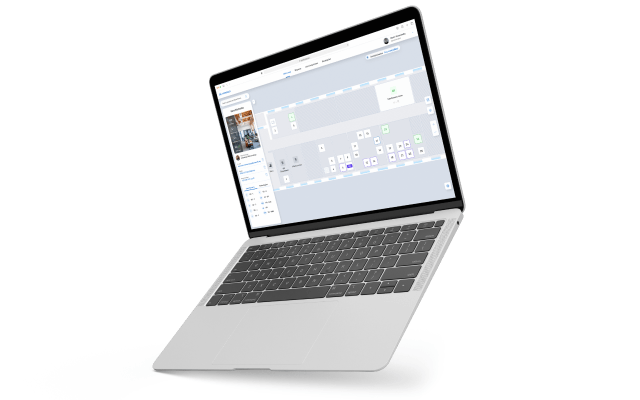
Launching a new product? Interactive ecommerce should be high on your list. A live retail launch feels more like a global product event, directly from your studio. Better still, it makes shopping truly social.
Take a haircare brand launching a new line of hair masks. Through shoppable livestreams, the team can introduce the full product range, explain the benefits of each formula, compare results on models in real time, answer questions from viewers, and unveil an exclusive livestream-only offer. All while helping customers understand exactly which product is right for them.
There is another side to this benefit, and it may be the most important one in a live commerce strategy. To maximize long-term value, IntexSoft develops AI-powered capabilities that extend the impact of every livestream. The session ends, but the data keeps working. Customer engagement tools continue tracking user behavior and recommending next best actions designed to turn viewers into repeat buyers or loyal fans. Over time, each interaction makes future recommendations, offers, and campaigns more precise. (We explore AI-driven retail engagement in more detail later in this article.)
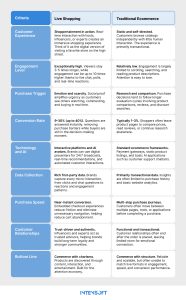
Retail winners are not replacing ecommerce with live streaming commerce. They are combining the strengths of both to create a single customer journey where convenience, engagement, and conversion reinforce each other. This approach is known as Unified Commerce.
IntexSoft always – without exception – recommends making both formats part of the same strategy. This is because classic ecommerce provides the operational foundation for the business: inventory management, logistics, payment processing, and CRM systems. Retail live streaming can create sudden surges in demand. For example, imagine selling 1,200 Elon Musk-themed T-shirts in just four minutes. Every order still needs to be processed, fulfilled, and delivered.
Why limit yourself to a single channel? Generation Z discovers products through TikTok Shop, creator-led content, or live interactions. Millennials still trust Facebook, email campaigns, and established brand websites. Different audiences follow different buying paths.
A unified strategy connects these journeys into an ecosystem.
Every successful livestream starts with a clear objective: awareness or conversion.
Planning should begin 2-3 weeks before the event. This is typically when registrations peak, giving brands the best chance to build an audience before the broadcast starts.
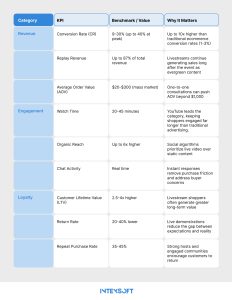
Just as importantly, define your live commerce KPIs and ROI metrics in advance. Make them as specific as possible, from add-to-cart rates and conversion performance to viewer retention and engagement levels.
This simple idea lies at the heart of interactive ecommerce. The industry even has a name for it: shoppertainment. If a livestream feels like a boring lecture, most viewers will leave within 10 seconds.
Top-performing brands understand this. They treat engagement as the priority and livestream sales as the outcome.
Viewers stay in livestreams 3-5 times longer than they do with pre-recorded videos when the content includes elements of entertainment, interactivity, or exclusive behind-the-scenes access.
If the scale of your ecommerce business allows it, create an appointment-viewing habit around your livestreams. Think of the model that once made TV shows a weekly ritual, or the approach used by Charlotte Tilbury. The brand regularly introduces new product lines and compares them with bestsellers and cult favorites.
This keeps users engaged between major purchases and gives customers a reason to return long before they need another product. As part of a broader retail digital transformation strategy, regular livestreams build an active community.
Your livestream must look flawless on a smartphone. After all, mobile devices account for 76% of all live commerce views worldwide. If your content is not designed for a vertical 9:16 format, global scale becomes difficult to achieve.
One of the most crucial mobile live commerce best practices is to build for smaller screens from the very beginning.
Make sure purchase buttons, product cards, and interactive elements do not block the host’s face or distract from the presentation.
IntexSoft turns livestreams into personalized recommendation feeds through the intelligent use of data and AI in live commerce personalization.
According to a 2026 Data Intelo report, such product suggestions increase conversion rates by 35-55% compared to traditional product displays.
There is another reason to start now. According to research cited by Business Insider, autonomous shopping assistants could account for nearly half of all ecommerce purchases by 2030. Retailers that invest in AI-based analysis today will have a significant head start tomorrow.
Do not assume that influencers with millions of followers will automatically increase livestream sales. In many cases, micro-influencers with audiences of 3,000 to 50,000 followers deliver higher conversion rates.
Research shows that shoppers are 60% more likely to choose stores that work with authentic and inclusive ambassadors who reflect their values, whether that means sustainability, a greener future, or other causes that resonate with their communities.
The goal is to find the most credible voice for your brand.
FOMO, the fear of missing out, is a driver of retail live streaming sales. Limited-time discounts compress decision-making. BigCommerce points to a Tommy Hilfiger stream where 1,300 sweatshirts disappeared within minutes. The formula is simple: exclusivity, scarcity, and immediate rewards available only during the event.
This strategy is also where gamification in ecommerce becomes especially effective.
Few channels are better at turning viewers into loyal customers than ecommerce live streaming. One proven tactic is to award double loyalty points for purchases made during the livestream. The payoff is twofold: stronger sales in the moment and higher retention over time. Customers are far more likely to return for future broadcasts when they know exclusive rewards will be available again.
Remember, customers can tell when expertise is real and when it is rehearsed. The most effective experts lean into the toughest questions instead of avoiding them.
With 83% of shoppers reading reviews before making a purchase, a livestream becomes an opportunity to address concerns on the spot, and remove barriers that might otherwise delay a purchase. In many cases, a single demonstration can replace dozens of product reviews.
There is another benefit. Every question, reaction, and objection becomes valuable first-party data in live commerce, helping retailers better understand customer intent and improve future offers and marketing campaigns.
Likes, comments, and shares are frequently 10 times higher in retail live streaming than in traditional video content.
Why? Because livestreams feel real. A missed word, an unexpected question, or a small production flaw can actually strengthen trust. These moments remind customers that they are interacting with real people, not a carefully edited marketing asset.
For Generation Z especially, that human connection often matters more than studio-quality presentation.
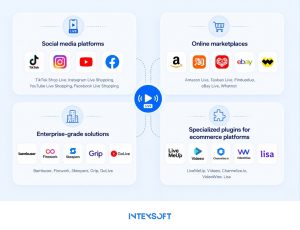
Here are the live commerce platforms IntexSoft has worked with most closely over the last years.
In the world of sales, LiveMeUp stands out among enterprise livestream solutions with instant inventory synchronization and one-click purchasing. We especially appreciate its live-to-evergreen model, which automatically converts completed livestreams into interactive product videos that continue attracting shoppers and generating orders long after the cameras stop rolling.
This gives retailers more wiggle room to maximize the return on every livestream. With replays accounting for up to 87% of revenue, a single 45-minute session continues closing sales for weeks after it goes live.
Videeo combines embedded livestreams with automated inventory and invoicing workflows, helping Shopify merchants manage sales with greater control. Its comment-to-buy engine allows customers to purchase directly from livestream comments across Facebook, Instagram, and TikTok.
Nearly $4 billion in transactions have been processed through the CommentSold ecosystem.
If you sell premium and high-ticket products, Channelize deserves a close look. Unlike many livestream shopping software providers, it does not take a percentage of your revenue. Every dollar stays yours.
Let’s start with what matters most. Amazon Live gives brands direct access to Amazon Prime customers: a premium community of active online buyers. That is one of the key reasons it is often featured in discussions of live streaming commerce explained for retailers.
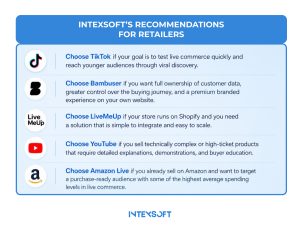
Follow the money. According to a March 2026 study by MRI-Simmons, Amazon Live shoppers spend an average of $501 over six months, compared to $292 for TikTok Shop users over the same period.
Yes, as IntexSoft mentioned earlier, 40% of Generation Z consumers and 54% of U.S. live commerce shoppers already buy through the platform, spending an average of $292 over six months. The audience is already in the room.
While most social content has a short lifespan, YouTube continues giving evergreen demand year after year. Trusted by every generation, it remains the leading video commerce platform for product discovery and research, attracting 70% of Generation Z and 63% of Millennials.
Use YouTube for high-ticket and technically sophisticated products. When a purchase requires trust, transparency, and information from every angle, few channels are better suited to the task. Buyers love having the space to research before they spend – YouTube was built for exactly that.
H&M, Levi’s, and L’Occitane all chose Bambuser for a common reason. Among today’s enterprise livestream solutions, this platform achieved a flawless reputation. Bambuser delivers true television-grade production quality.
Why Bambuser Remains the Benchmark for Interactive Retail Ecommerce Solutions
At scale, livestreams should operate with a delay of no more than 2-5 seconds. For one-to-one consultations, latency must stay below 500 milliseconds. Any higher, and the conversation starts to feel unnatural.
The platform must be engineered for spikes. A successful livestream can unleash a flood of traffic and orders within minutes.
IntexSoft recommends cloud and SaaS deployment models whenever possible. They already account for 78.5% of the market and make it easier to handle traffic spikes through on-demand scaling.
Much like Bambuser, one of the leading enterprise livestream solutions discussed earlier, we rely on three layers of protection against ecommerce fraud:
From our experience, these are the integration priorities that matter most:
The final point brings us back to first-party data. Every live sale produces valuable customer intelligence. We turn that intelligence into a competitive advantage for your store. You gain:
IntexSoft starts with rapid hypothesis validation and platform selection. For many retailers, TikTok Shop provides the ideal testing ground: immediate access to a built-in audience and no need for major infrastructure investments.
Professional livestreaming requires more than a smartphone. Remember, a solid entry-level setup usually requires several thousand dollars’ worth of camera and lighting equipment.
Beyond getting the production side ready, prepare a synchronized product catalog, and we’ll handle the integration.
Then spend the next 30 days broadcasting 3 to 5 times per week. In ecommerce live streaming, frequency is the entry ticket to TikTok’s algorithmic visibility.
Target a 5% to 15% conversion rate for mass-market retail. Anything below 5% should raise questions.
The proof of concept stage is complete. Now build a content calendar and a detailed Run of Show for every livestream. Then focus on the bigger challenge in product expansion: creating an appointment viewing strategy. Nike did not build audiences around isolated events. It built habits. Your shoppable livestreams should do the same.
IntexSoft will identify the most effective way to showcase your products, blending storytelling with live product testing to demonstrate real-world value and everyday use.
Sequence the merchandise mix thoughtfully. Lead with expensive products, and you risk stalling buyer interest. Start with a lower-priced hero product to build demand, then unveil new releases and higher-ticket items when the audience is at its largest.
We also leverage the psychology of Fear of Missing Out (FOMO), but make it real. The good idea is to replace generic giveaways with countdown timers and limited-availability offers that create genuine scarcity. H&M Group’s annual digital channels report revealed: 40% of livestream purchases occur within the first 10 minutes. You have to pursue a viewer buy during that window.
Social platforms are rented land. At the third stage, retailers need to bring customers back to their own website, where they can own both the customer relationship and first-party data in live commerce. LiveMeUp for Shopify stores or Bambuser provide an effective path to an owned-site strategy.
Push beyond a three-second delay, and you can lose up to 50% of engagement. Then close the gap between interest and purchase with one-click page checkout built directly into the player. The shortest path converts best.
The final phase of any enterprise guide to live commerce platforms reveals a simple truth: growth without automation does not scale. Every manual process becomes a tax on growth. IntexSoft enterprise solutions eliminate that tax through automation, streamlined operations, and lower operating costs.
The next step is particularly relevant for enterprise scaling. Once retail live streaming becomes a meaningful revenue channel, availability becomes as important as efficiency. We have already discussed virtual hosts and digital clones. Treating them as a cost-cutting tool misses the bigger picture. They transform idle hours into revenue-generating hours. Between 11:00 PM and 7:00 AM, a single avatar can bring in $500 to $3,000 while maintaining a permanent sales presence.
IntexSoft also builds a Live-to-Evergreen engine. AI automatically converts completed livestreams into short-form shoppable videos and interactive VOD replays that keep converting.
This article has explored how interactive ecommerce is reshaping retail, turning product demonstrations into content and content into revenue. With 2027 right around the corner, the wave continues to build.
The brands that thrive will be the ones that own the audience, own the data, and own the livestream sales channel.


This article highlights the significance of integrating the best marketing automation for ecommerce. It covers how ecommerce business owners can benefit from the right marketing automation solution.
This article breaks down what hyper-personalization means for ecommerce and how it can support business growth.
IntexSoft focuses on how real-time lead scoring works, where traditional methods fall short, and what it takes to implement a more accurate system.